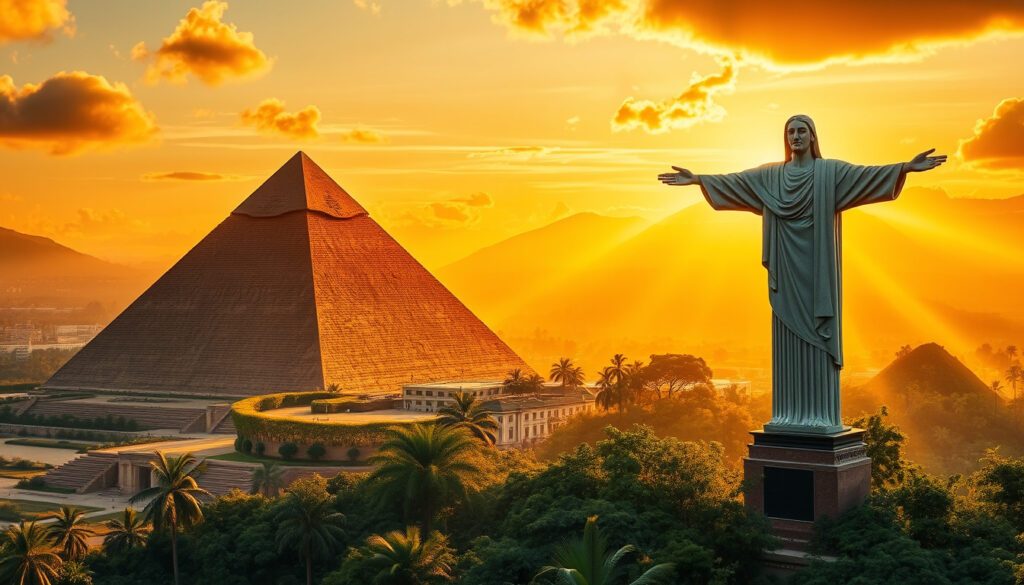
Seven Wonders of the World: Ancient, New & Natural Lists Compared
Ask someone to rattle off the seven wonders of the world, and you’ll hear different things depending on who’s talking. The phrase has been used for three very different lists—ancient, modern, and natural—and most people mix them up.
Ancient list origin: 2nd century BCE ·
New7Wonders campaign voters: Over 100 million ·
Original wonders still standing: 1 (Great Pyramid of Giza) ·
New7Wonders declared: July 7, 2007 ·
Natural wonders count: 7
Quick snapshot
- Only the Great Pyramid of Giza survives from the ancient list (Encyclopaedia Britannica)
- New7Wonders were announced July 7, 2007 after a global vote (Encyclopaedia Britannica)
- Natural wonders list finalized on November 11, 2011 (New7Wonders of Nature (official campaign body))
- Exact composition of the original list varies by ancient source (Encyclopaedia Britannica)
- No universally accepted “official” list of seven wonders exists (Encyclopaedia Britannica)
- c. 140 BCE – Antipater of Sidon compiles the first known list (Encyclopaedia Britannica)
- 2000 – New7Wonders Foundation launches voting campaign (Encyclopaedia Britannica)
- 2007 – Winners announced in Lisbon (Encyclopaedia Britannica)
- 2011 – Natural wonders list released (Encyclopaedia Britannica)
- Unofficial “eighth wonder” candidates (Angkor Wat, Niagara Falls) continue to circulate
- Regional wonder lists (e.g., Seven Wonders of Canada) may gain traction
The four key facts from the research show a clear pattern: the ancient list is nearly all lost, the modern list is entirely man‑made, and the natural list spans the globe.
| Fact | Value | Source |
|---|---|---|
| Oldest surviving wonder | Great Pyramid of Giza (c. 2560 BCE) | Encyclopaedia Britannica |
| Most recent addition | New7Wonders (2007) | Encyclopaedia Britannica |
| Only wonder in Europe (new list) | Colosseum (Rome, Italy) | Encyclopaedia Britannica |
| Most voted wonder | Great Wall of China | BBC Bitesize (UK educational publisher) |
Where were the original 7 wonders of the world?
List of the original seven wonders
- Great Pyramid of Giza (Egypt) – still standing
- Hanging Gardens of Babylon (Iraq) – existence debated
- Statue of Zeus at Olympia (Greece) – destroyed by fire
- Temple of Artemis at Ephesus (Turkey) – destroyed by fire
- Mausoleum at Halicarnassus (Turkey) – destroyed by earthquake
- Colossus of Rhodes (Greece) – destroyed by earthquake in 226 BCE
- Lighthouse of Alexandria (Egypt) – destroyed by earthquake
These seven wonders were concentrated around the eastern Mediterranean basin. The only one that survives largely intact is the Great Pyramid of Giza (Encyclopaedia Britannica (reference work on classical history)).
Where are the new 7 wonders?
Complete list with locations
- Great Wall of China (China)
- Petra (Jordan)
- Christ the Redeemer (Brazil)
- Machu Picchu (Peru)
- Chichén Itzá (Mexico)
- Colosseum (Italy)
- Taj Mahal (India)
Announced on July 7, 2007, after a campaign that drew more than 100 million votes reported by BBC Bitesize (UK educational publisher), the New7Wonders span seven countries on three continents. All still exist. Notably, the Great Pyramid of Giza is not on this list—it was treated separately as an honorary wonder (Encyclopaedia Britannica (reference work on modern history)).
The global vote gave every internet user a say, but critics argue the list favors tourist‑friendly sites over archaeological or cultural depth. The campaign itself claims over 500 million votes worldwide (New7Wonders of Nature (official campaign body)).
What are the top 7 natural wonders of the world?
Official list of the natural wonders
- Amazon rainforest and river (South America, 9 countries)
- Ha Long Bay (Vietnam)
- Iguazú Falls (Argentina/Brazil)
- Jeju Island (South Korea)
- Komodo Island (Indonesia)
- Puerto Princesa Underground River (Philippines)
- Table Mountain (South Africa)
The New7Wonders of Nature campaign released its final seven on November 11, 2011 (Table Mountain (official site for the only urban natural wonder)). The list is geographically broad, includes transnational sites like the Amazon, and was chosen from 28 finalists (New7Wonders of Nature (official campaign body)).
Which is the 8th wonder of the world?
Unofficial contenders for eighth wonder
- Angkor Wat (Cambodia)
- Taj Mahal (India) – notably not included in the New7Wonders list
- Niagara Falls (USA/Canada)
- Great Pyramid of Giza (Egypt) – often called the 8th wonder of the ancient world
No official “eighth wonder” exists. The term is used informally for sites that attract exceptional awe. Common candidates include Angkor Wat and Niagara Falls, but no governing body has ever designated an eighth wonder (TheCollector (history and culture publication)).
What was the original 7 wonders?
Hellenic travel guide origins
The original list was compiled by Antipater of Sidon around 140 BCE as a kind of tourist highlights of the Hellenic world (Encyclopaedia Britannica (reference work on classical history)). Most entries were destroyed by earthquake or fire; only the Great Pyramid remains. The list reflects the geographic limits of the time—everything was within the Mediterranean perimeter.
Later writers added and removed items freely. The “canonical” list we know today was standardized by Renaissance scholars, not by any ancient authority. That means the seven wonders were never set in stone—literally or metaphorically.
How the three lists compare side by side
Three lists, one common name, but each serves a different audience and era. The table below shows the key contrasts.
| Dimension | Ancient Wonders | New7Wonders (2007) | New7Wonders of Nature (2011) |
|---|---|---|---|
| Selection method | Hellenic travel guide (Antipater) | Global public vote | Global public vote |
| Number surviving | 1 (Great Pyramid) | 7 (all) | 7 (all) |
| Geographic spread | Eastern Mediterranean | 3 continents | 5 continents |
| Type | Human‑made (except debated Hanging Gardens) | Human‑made | Natural |
| Year finalized | c. 140 BCE | July 7, 2007 | November 11, 2011 |
The implication: the ancient list is nearly all lost; the modern lists are fully intact. For travelers, the New7Wonders are all visitable today, while the ancient ones require imagination—and a trip to Egypt for the Pyramid.
Timeline of the seven wonders
- – Antipater of Sidon compiles the original list.
- – Colossus of Rhodes destroyed by earthquake.
- – New7Wonders Foundation launches voting campaign.
- – New7Winners announced in Lisbon.
- – Seven Natural Wonders organization releases their list.
What we know for sure and what remains unclear
Confirmed facts
- The Great Pyramid of Giza is the only ancient wonder still standing (Encyclopaedia Britannica).
- New7Wonders list was announced July 7, 2007 (Encyclopaedia Britannica).
- Natural wonders list was announced November 11, 2011 (New7Wonders of Nature).
What remains unclear
- Exact composition of the original list varies by ancient source (Encyclopaedia Britannica).
- No universally accepted “official” list of seven wonders exists.
Voices from the experts
“The New7Wonders campaign drew more than 100 million votes in the public poll.”
“Table Mountain is the only New7Wonders of Nature located in an urban area.”
“The New7Wonders of Nature finalists included 28 contenders before the final seven were selected.”
New7Wonders of Nature (official campaign body)
“The ancient list was created in an era when travel was concentrated around the eastern Mediterranean, which explains its regional bias.”
Encyclopaedia Britannica (reference work on classical history)
The three lists of seven wonders reflect three different eras and purposes. For anyone planning a trip or a trivia night, the key is: the ancient list is mostly gone, the new list is human‑made and fully standing, and the natural list covers the planet’s most spectacular landscapes. For the curious traveler, the choice is clear: visit the New7Wonders for guaranteed awe, explore the natural ones for untamed beauty, and make a pilgrimage to Giza to stand before the only original survivor.
en.wikipedia.org, enchantedlearning.com, scribd.com, biblicalarchaeology.org, exoticca.com
For a deeper look at how these lists compare, see the different lists of wonders.
Frequently asked questions
Why are there different lists of seven wonders?
Multiple lists exist because the phrase “seven wonders” has been applied to different categories over time—ancient, modern, and natural—each created by different organizations for different purposes.
Who decides which wonders make the list?
The ancient list was compiled by Greek writers; the New7Wonders and New7Wonders of Nature were chosen by global public vote; there is no single official authority.
Can the list of seven wonders change?
The ancient list is fixed by tradition, but new lists can be created. There is no mechanism to update an existing “official” list.
How many of the original seven wonders are still standing?
One—the Great Pyramid of Giza. All others have been destroyed by earthquakes, fire, or other causes (Encyclopaedia Britannica).
Is the Eiffel Tower one of the seven wonders?
No. The Eiffel Tower is not on any of the three major lists (ancient, New7Wonders, or natural wonders).
What makes a wonder qualify as natural?
In the context of the New7Wonders of Nature, sites are natural formations not significantly altered by human activity. The campaign required that they be “naturally occurring” landscapes, seascapes, or ecosystems.
Related reading
More related posts
 Giltrap Audi North Shore: Reviews, Used Cars & Awards
 Countdown Mailer This Week – Step-by-Step Setup Guide
 Houses for Sale in Raglan: UK & NZ Market Comparison
 Mitre 10 MEGA Hamilton: Locations, Hours, Phone & More
 Pullman Auckland Airport Reviews: Is It Worth the Luxury?
 Bay of Islands Accommodation: Best Paihia & Kerikeri Stays
 NZD to Pound Sterling Exchange Rate: Convert, Forecast & History
 Chernobyl Miniseries Characters: People & Historical Accuracy