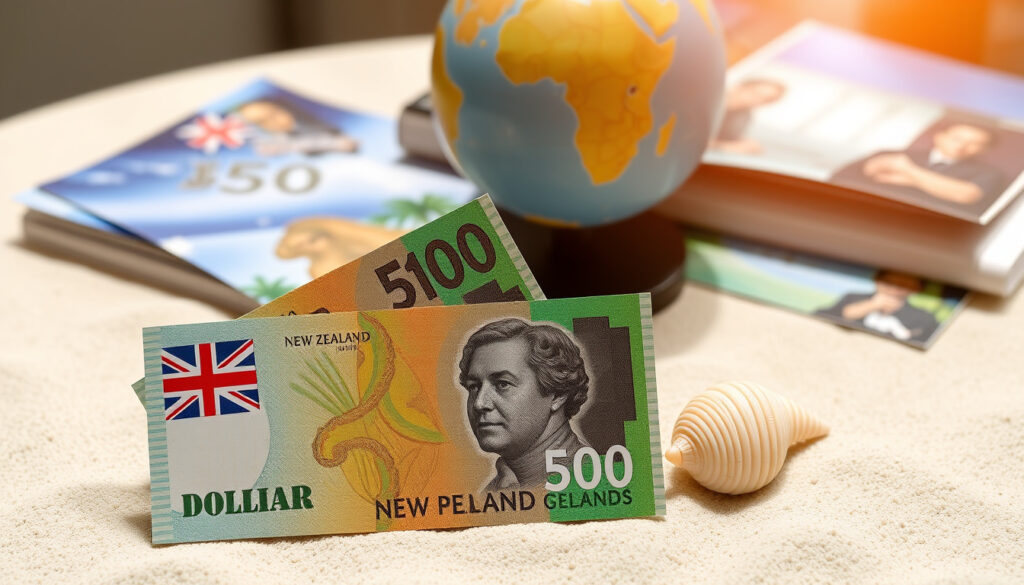
NZ Dollar to Fiji Dollar: Exchange Rates & Travel Facts
Anyone who’s priced a Fiji holiday from New Zealand has hit the same wall: the exchange rate quoted online isn’t the rate you’ll actually get. The Fijian dollar is pegged to a basket of six currencies, including the NZD, and the Reserve Bank of Fiji publishes an official rate every business morning.
Mid-market exchange rate (as of Oct 2025): 1 NZD = 1.2816 FJD (XE, currency data provider) ·
Distance between New Zealand and Fiji: ~2,000 km (1,240 mi) ·
Fiji international dialing code: +679
Quick snapshot
- Fiji’s official currency and legal tender is the Fijian dollar (FJD) (Remitly, money transfer service)
- The Reserve Bank of Fiji manages the exchange rate under a fixed-rate system (Reserve Bank of Fiji, central bank)
- New Zealand citizens can visit Fiji visa-free for up to 4 months (Wise, international money transfer platform)
- How widely NZ dollars are accepted by smaller Fijian businesses — evidence is mainly anecdotal (VisaJa, Fiji travel information)
- Whether the Fiji Water boycott will change bottling practices long term (ongoing debate) (VisaJa, Fiji travel information)
- The Reserve Bank of Fiji publishes an official FJD-USD rate at 9:00 a.m. on business days and uses it to calculate other currency rates (Reserve Bank of Fiji, central bank)
- Quoted rates are time-sensitive — check the live figure immediately before exchanging (XE, currency data provider)
- Notify your bank, check overseas-use settings, and confirm withdrawal and purchase limits before departure (Wise, international money transfer platform)
- Carry a mix of FJD cash and a card to cover resorts and cash-only villages (Wise, international money transfer platform)
Six numbers capture most of what NZ travellers need to know before booking Fiji — and one of them explains why the money planning deserves more than a Google search.
| Fact | Value |
|---|---|
| Official currency | Fijian dollar (FJD) (Remitly, money transfer service) |
| Mid-market rate (NZD → FJD) | 1 NZD ≈ 1.28 FJD (XE, currency data provider) |
| Distance NZ–Fiji | ~2,000 km (1,240 mi) (Travel Money NZ, NZ currency exchange specialist) |
| Flight time (Auckland to Nadi) | ~3 hours (Travel Money NZ, NZ currency exchange specialist) |
| Currency system | Fixed-rate peg to a weighted basket of six currencies (Reserve Bank of Fiji, central bank) |
| Visa-free stay for NZ citizens | Up to 4 months (Wise, international money transfer platform) |
| Population of Fiji | Approximately 900,000 |
| Country code | +679 |
How much is 1000 Fiji dollars in NZ dollars?
At the mid-market rate quoted by XE (currency data provider), 1 NZD buys 1.2816 FJD. That puts 1,000 FJD at roughly 780 NZD. The catch: a quoted rate is a reference rate — the rate you actually receive at a bank, airport counter, ATM or card network can differ because of margins and fees (XE, currency data provider).
- 1,000 FJD in NZD: 1,000 ÷ 1.2816 ≈ 780 NZD
- Reference rates vary by provider: retrieved data showed roughly 1.23–1.28 FJD per NZD depending on source and timestamp (OFX, currency exchange service)
- What you actually receive: the provider’s margin and fees sit on top of the reference rate
If you’re also tracking the New Zealand dollar against the US dollar, our New Zealand Dollar to USD guide explains the cross-currency mechanics in detail.
How much is 200 US dollars in Fiji dollars?
- Official anchor: the Reserve Bank of Fiji publishes the FJD-USD rate at 9:00 a.m. on business days and uses it to calculate all other rates, including NZD/FJD (Reserve Bank of Fiji, central bank)
- The math: divide 200 by the day’s USD-FJD reference rate, then let your provider’s margin adjust the result
- Cross-currency catch: the NZD’s movement against the USD affects the number you’ll see, even though you’re ultimately converting NZD to FJD
The pattern: the Fijian dollar’s peg to a six-currency basket means every conversion is really a triangulation — your money moves through the basket’s weighted values before it lands in FJD.
Are New Zealand dollars accepted in Fiji?
Fiji’s official currency and legal tender is the Fijian dollar (Remitly, money transfer service). NZD is not legal tender, but it is commonly exchanged because of Fiji’s proximity and travel links with New Zealand (VisaJa, Fiji travel information). Whether a shop will take your NZD directly is another question.
What currency is used in Fiji?
- The Fijian dollar (FJD) is the official currency issued by the Reserve Bank of Fiji (Remitly, money transfer service)
- The Reserve Bank of Fiji operates a fixed exchange-rate system, pegging the FJD to a weighted basket containing the NZD, AUD, USD, JPY, GBP and EUR (Reserve Bank of Fiji, central bank)
- NZD can generally be exchanged at Nadi International Airport and at authorised foreign-exchange providers around the main tourist centres
Should I exchange NZD to FJD before traveling?
- Cash first: cash is particularly useful at local markets, small businesses, some transport providers and remote locations (Travel Money NZ, NZ currency exchange specialist)
- Cards second: major hotels, resorts, larger restaurants and established tourism businesses commonly accept Visa and Mastercard (Fiji Journal, Fiji travel guide)
- The practical mix: a modest amount of FJD in your pocket, a low-fee card for bigger bills, and a plan to use ATMs for refills
Card acceptance varies by merchant, location, card network, connectivity and possible surcharges (Fiji Journal, Fiji travel guide). A resort in Nadi will happily take your card; a kava stall in a village market will not.
Why this matters: arriving with only a card can leave you stranded at exactly the places that make Fiji worth visiting — and arriving with only NZD cash leaves you at the mercy of whoever offers to change it. The answer is a deliberate mix.
The implication: your payment strategy directly determines how much of your budget reaches your destination, regardless of the exchange rate on the day.
Is Fiji close to New Zealand?
Fiji sits roughly 2,000 km (1,240 mi) from New Zealand — close enough that NZ dollars are a standard item in Fijian tourist areas (VisaJa, Fiji travel information). The distance numbers above translate into a direct flight of around 3 hours from Auckland.
How far is Fiji from New Zealand?
- Distance: approximately 2,000 km (1,240 mi) (Travel Money NZ, NZ currency exchange specialist)
- Flight time Auckland to Nadi: around 3 hours direct (Travel Money NZ, NZ currency exchange specialist)
- Visa-free window: New Zealand citizens can enter Fiji without a visa for stays up to 4 months (Wise, international money transfer platform)
For New Zealand travellers, Fiji is not a long-haul production. A 3-hour flight makes a long weekend feasible — and that changes the currency question: short stays with a card and a small cash cushion are workable; longer stays need a proper money plan.
The trade-off: easy proximity means repeat visits — and every visit carries the same currency spread. The distance may be short, but the margin on your dollars never takes a holiday.
Can a NZ citizen live in Fiji?
New Zealanders get a visa-free window of up to 4 months in Fiji (Wise, international money transfer platform) — long enough to test whether the island pace is real or just a holiday mood. The harder part is the money logistics once you’re there.
What visa do NZ citizens need for Fiji?
- Short stays: visa-free for New Zealand citizens for up to 4 months (Wise, international money transfer platform)
- Long-term: any stay beyond that requires a visa or permit application through Fijian immigration
- Property: buying land in Fiji comes with separate foreign-ownership rules — a visa does not automatically grant purchase rights
Cost of living in Fiji vs NZ
- ATM withdrawals can involve both the Fiji ATM operator’s fee and your NZ card issuer’s overseas or foreign-exchange fee (Remitly, money transfer service)
- International cards are reported to work at ATMs operated by major Fiji banks in principal visitor locations, although fees and limits may apply (VisaJa, Fiji travel information)
- Cash is the default at local markets, small businesses and transport providers — budget your ATM visits accordingly
The trade-off: the 4-month visa-free window makes Fiji one of the easiest Pacific nations for New Zealanders to try living in. The currency friction — ATM fees, card acceptance gaps, and the daily NZD-to-FJD spread — is the real tax on that experiment.
What is the biggest issue in Fiji?
Climate change sits at the top — rising sea levels and intensifying cyclones are reshaping the islands. On the economic side, the Reserve Bank of Fiji’s choice of a fixed exchange-rate system, pegging the dollar to a six-currency basket, shows how much the country values stability over flexibility (Reserve Bank of Fiji, central bank).
What to be careful of in Fiji?
- Cash running out: smaller towns and villages operate largely on cash; plan withdrawals before leaving tourist centres (Travel Money NZ, NZ currency exchange specialist)
- Card connectivity: acceptance varies by location and network, so carry FJD as a backup (Fiji Journal, Fiji travel guide)
- Cyclone season: monitor official weather warnings before and during your trip
What does 679 mean in Fiji?
- 679 is Fiji’s international dialing code — the +679 prefix on every Fijian phone number
- From New Zealand, you dial +679 followed by the local number
- It matters for travellers setting up eSIMs, booking transfers, or keeping in touch with accommodation
What this means: whatever headline grabs your attention before you arrive — climate, economy, plastic — the practical travel advice stays the same: carry FJD cash, keep a card as backup, and check official alerts rather than social media.
Why are people boycotting Fiji water?
The boycott debate around FIJI Water is a live one, and it’s the kind of controversy that makes travellers pause at the supermarket shelf. The water is genuinely from Fiji, and the safety record is solid — but the environmental arguments are harder to swallow.
Is Fiji bottled water really from Fiji?
- Yes. FIJI Water is drawn from a confined aquifer in Viti Levu, Fiji’s main island, and bottled at the source
- The brand’s entire marketing identity rests on that remote, tropical origin
Why do people say FIJI Water is bad?
- Plastic pollution: single-use bottles shipped worldwide are a visible environmental flashpoint
- Water rights: a foreign-owned company extracting Fijian water for export raises questions about local control
- Carbon footprint: shipping water across the Pacific makes for an easy climate target
Is it safe to drink FIJI Water now?
- Yes. FIJI Water is a regulated food product with international distribution and meets food-safety standards
- The boycott debate targets environmental and social practice, not water quality
The catch: you can, with a clear conscience, say no to FIJI Water — not because it’s unsafe, but because single-use plastic shipped halfway around the planet is hard to defend. A refillable bottle is the cheaper and simpler choice anyway.
What’s confirmed and what’s still open
Confirmed facts
- The Fijian dollar is Fiji’s official currency and legal tender (Remitly, money transfer service)
- The Reserve Bank of Fiji manages the exchange rate through a fixed-rate peg (Reserve Bank of Fiji, central bank)
- New Zealand citizens can stay in Fiji visa-free for up to 4 months (Wise, international money transfer platform)
What’s unclear
- How widely NZ dollars are accepted by businesses in Fiji — evidence is mainly anecdotal (VisaJa, Fiji travel information)
- What exact rate any provider will offer on a given day — quoted rates vary by provider and timestamp (OFX, currency exchange service)
- Whether the Fiji Water boycott will shift bottling practices long term (ongoing debate)
- How much of the quoted mid-market rate you’ll lose to margins at any specific bank, ATM or airport counter on a given day (XE, currency data provider)
A quoted NZD/FJD rate is normally a market or reference rate; the rate received at a bank, airport counter, ATM or card network can differ because of margins and fees.
— XE, currency data provider
Travellers should notify their bank, check overseas-use settings and confirm withdrawal and purchase limits before departure.
— Wise, international money transfer platform
For New Zealand travellers, the money decision is clear: plan a cash-plus-card mix before you fly, or accept that the exchange margin will quietly plan it for you. The spread between the mid-market rate and the rate you actually receive is the one travel expense you can actually control.
Frequently asked questions
How do I convert NZD to FJD?
Divide the NZD amount by the current NZD-to-FJD mid-market rate, or multiply the FJD amount by that rate to get NZD. At 1 NZD ≈ 1.2816 FJD, 1,000 FJD is about 780 NZD. The rate you receive from a bank, ATM or exchange counter will include margins and fees on top of the mid-market rate.
What is the best time to exchange currency for Fiji?
The Fijian dollar is pegged to a weighted basket of six currencies, so the NZD/FJD rate moves with global currency movements. Check the mid-market rate a few days before you travel and compare it with the rate your provider offers — that spread is the real cost. Avoid last-minute airport exchanges where the margin is usually at its widest.
Do I need a visa for Fiji if I am a New Zealand citizen?
No, for stays up to 4 months. New Zealand citizens can enter Fiji visa-free, and any longer stay requires a visa or permit application through Fijian immigration.
Is it safe to travel to Fiji right now?
The main safety considerations are practical: card acceptance varies by location and network, cash is still essential outside tourist centres, and cyclone season brings weather alerts. Check the New Zealand Ministry of Foreign Affairs and Trade travel advisory before departure and monitor local weather warnings while you’re there.
What is the best way to send money to Fiji from New Zealand?
Compare providers that specialise in international transfers, such as Wise and Remitly, and factor in both the exchange-rate margin and any transfer fee. The mid-market rate published by currency data providers like XE is the benchmark — the rate your chosen provider offers will sit on top of it.
Can I use my New Zealand bank card in Fiji?
Yes, international cards work at ATMs operated by major Fiji banks in principal visitor locations, though fees and limits apply. ATM withdrawals can involve both the Fiji ATM operator’s fee and your NZ card issuer’s overseas or foreign-exchange fee.
Are there any travel warnings for Fiji from New Zealand?
The main warnings relate to natural hazards and practical preparations. Check the New Zealand Ministry of Foreign Affairs and Trade travel advisory before departure, monitor official weather alerts during your stay, and carry enough FJD cash for areas where card connectivity is unreliable.
More related posts
 Why Donald Trump hasn’t won the Nobel Peace Prize
 BOP Rotorua Heavy Rain Warning: MetService Alert Levels Explained
 Certificate of Entitlement UK: Cost, Validity, and How to Apply
 Cast of Little Fires Everywhere: Complete Actor Guide
 Love and Other Drugs: Disease, True Story, and Reviews
 How Many Popes Have There Been? Total Count and Fascinating Facts
 Taupo to New Plymouth: Driving, Flights, Bus & Best Stops
 ANZ New Zealand SWIFT Code: ANZBNZ22 for International Transfers