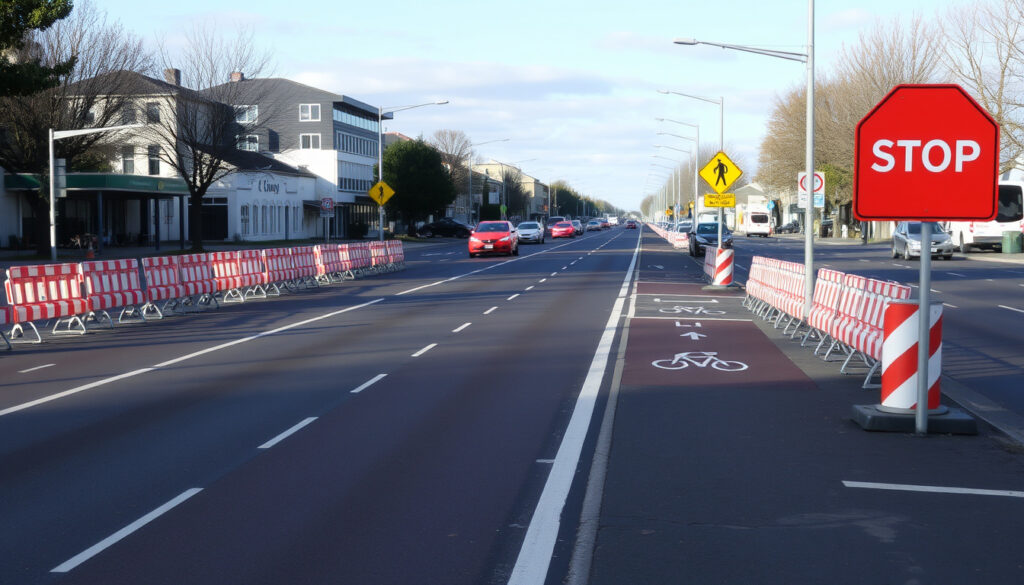
Featherston St Road Makeover Palmerston North: Cycleway Controversy
Featherston Street in Palmerston North has recorded 442 crashes over the past decade, including two fatal incidents. A new cycleway and safety upgrades completed in 2024 have split the community—drivers facing delays from in-lane bus stops, while cyclists and pedestrians gained protected infrastructure.
Project length: 750-metre stretch · Completion year: 2024 · Key features: separated cycleway, in-lane bus stops · Council vote margin: barest margin · Upgrade phase: first section between Aroha and North
Quick snapshot
- 442 crashes on Featherston Street over the past decade (Palmerston North City Council)
- 2 fatal crashes; 28 cyclist and 19 pedestrian incidents in that same period (Palmerston North City Council)
- Council voted June 2024 to retain four in-lane bus stops by the barest margin (Palmerston North City Council)
- First cycleway section built 2024 between Aroha and North Streets (Palmerston North City Council)
- Exact scope of future construction phases beyond current 750m stretch
- Long-term traffic flow impacts now that in-lane bus stops remain
- When NZ Transport Agency – Waka Kotahi will resume funding for remaining sections
- Council discussions began 2022 when funding first appeared viable (Palmerston North City Council)
- Three co-design sessions ran May–June 2023 (Palmerston North City Council)
- 750m stretch finished mid-2024; remainder design phases now complete (Palmerston North City Council)
- Remaining Featherston Street sections between Botanical and Vogel Streets on hold pending funding
- Council monitoring traffic outcomes and functionality through 2025
- Future phases dependent on renewed Waka Kotahi support
Featherston Street’s transformation reflects a deliberate council choice to prioritise vulnerable road users, backed by a decade of crash data.
| Label | Value |
|---|---|
| Street | Featherston Street, Palmerston North |
| Length upgraded | 750 metres |
| Year completed | 2024 (first section) |
| Main features | Separated cycleway, raised platforms, in-lane bus stops |
| Council decision | Approved June 2024 by narrow margin |
| Fatal crashes (decade) | 2 |
| Total crashes (decade) | 442 |
| Cycleway width | 1.8 metres |
| New pedestrian crossings | 5 |
| Average bus stop time | 15 seconds |
What are the Featherston Street safety upgrades?
The upgrades aim to address a decade of crash data that put Featherston Street among Palmerston North’s most hazardous corridors. The Palmerston North City Council identified 442 crashes between 2014 and 2024, including 28 involving cyclists and 19 involving pedestrians—plus two fatal incidents. The project targets these vulnerable road users specifically, rather than focusing on vehicle throughput.
— Palmerston North City Council, on the safety rationale for the project
Cycleway and pedestrian changes
The cycleway is uni-directional (one-way) on both sides of the road, running 1.8 metres wide with a rubber-and-concrete barrier separating it from vehicle lanes. Five new pedestrian crossings were installed across the upgraded section, with raised platforms added outside Central Normal School and Palmerston North Boys’ High School to slow vehicles near school entrances. These raised crossings were explicitly designed to make speeds safer at known school zones.
A shared-path option was ruled out early after the investigation found major safety risks from high street traffic and numerous driveways. Instead, the uni-directional design on both sides scored highest for safety during co-design sessions and was favoured by most participants.
Cyclists gained a dedicated, separated lane. Drivers lost direct lane access at several points and now share road space with buses stopping in traffic. The data suggests the trade-off leans toward protecting the most vulnerable—but that is cold comfort to a car full of shopping stuck behind a bus.
Intersection modifications
The cycleway sits slightly raised above the road surface, creating a physical buffer without using planter boxes. Higgins, the contractor awarded the construction contract, built the first section in two stages: Aroha to Rangitikei Streets ran from 12 January to mid-February, with Rangitikei to North Streets completed from mid-February to late March. These raised platforms are consistent across the entire 750-metre stretch.
The design prioritises cyclists and pedestrians over vehicle convenience—a choice the council defended with safety data but which residents have challenged with direct experience of congestion.
The implication: the design represents a deliberate choice to protect cyclists and pedestrians over vehicle convenience. Whether that exchange produces measurable safety gains will depend on follow-up data the council is now collecting.
What changes were made in the 2024 makeover?
The completed 750-metre stretch between Aroha and North Streets opened mid-2024. Four in-lane bus stops were built as part of the design—meaning buses stop directly in traffic rather than pulling into a dedicated bay. Each stop adds roughly 15 seconds of delay to vehicles following a bus, according to council data on average stop times.
Bus stop placements
The four in-lane bus stops are the feature drivers most object to. Rather than building pull-out bays (which require more road width and investment), the design keeps buses in the travel lane. Council engineers argued this is standard urban transit practice and that the 15-second average stop impact is manageable. The Palmerston North City Council maintained that in-lane stops actually improve bus reliability by eliminating the difficulty of re-entering traffic from a pull-out.
Road layout details
The raised cycleway runs the full length of the completed section, with the separation barrier made of rubber or concrete modules rather than decorative planters. Raised pedestrian platforms appear at all new crossing points, while existing crossings near the two schools were upgraded to raised platforms as part of the work. The layout retains one traffic lane in each direction throughout the 750-metre stretch.
What this means: the makeover is not a road widening project. The council deliberately maintained vehicle capacity while adding cycling and pedestrian infrastructure within the existing footprint. That engineering decision is precisely why the in-lane bus stops exist.
Why is the Featherston Street makeover controversial?
The controversy crystallised around the in-lane bus stops and broader question of who Featherston Street is for. Public feedback during the co-design stages was sharply divided, and the June 2024 council vote passed by the barest possible margin.
— NZ Herald – Manawatu Guardian report on the June 2024 council vote
Public opposition
Drivers described the layout as an “absolute nightmare,” and social media commentary from local residents reflected frustration about lane reductions and increased congestion at peak hours. Many drivers argued the redesign prioritised a small number of cyclists at the expense of the majority who use Featherston Street by car.
Council vote
The vote to retain the layout—including all four in-lane bus stops—came in June 2024. Several councillors reportedly had reservations about the bus stop configuration but ultimately voted with the majority. The decision effectively locked in the design for the completed section and set a precedent for future phases. A traffic-functionality report was discussed at the council’s Economic Growth Committee in November 2024, presenting findings that partly contradicted the public’s experience.
The pattern: the council has data showing safety improvements, the public has direct experience of delays, and neither side is fully wrong. That tension is where the controversy lives.
What is the timeline for Featherston Street upgrades?
The project’s history stretches back to 2022, when council first received notification that funding could be obtained from NZ Transport Agency – Waka Kotahi. The timeline reflects years of planning, community engagement, and construction spread across multiple stages.
- 2022: Official council discussions began after Waka Kotahi signalled funding availability
- May 2023: Second co-design session held, focused on three proposed cycleway options between North Street and Aroha Street
- June 2023: Third co-design session gathered feedback on two options for the full length between Botanical Road and Vogel Street
- Late 2023: Waka Kotahi paused funding for the remainder of Featherston Street; construction of remaining sections halted
- January–February 2024: Stage 1 construction (Aroha to Rangitikei Streets) completed
- February–March 2024: Stage 2 construction (Rangitikei to North Streets) completed
- Mid-2024: 750m stretch finished and opened
- June 2024: Council voted to retain the layout
- September 2024: Elected members held design workshop; reviewed final proposed design before Waka Kotahi review
- November 2024: Traffic functionality report discussed at Economic Growth Committee
- April 2025: Elected members received report on Featherston Street functionality
The first 750 metres took roughly three years of planning and public engagement before construction began.
How has the makeover impacted traffic and safety?
The November 2024 traffic report presents data that cuts against the public narrative. According to the Palmerston North City Council, findings show measurable improvements in pedestrian and cyclist safety at the upgraded section—though vehicle journey times have increased compared to the pre-construction baseline. The report was discussed at the Economic Growth Committee, with members receiving the full functionality analysis in April 2025.
Bus and cycle integration
The integration of cycle lanes with in-lane bus stops creates a configuration where buses, cyclists, and following vehicles must negotiate shared space. Council engineers argue the design is consistent with best-practice urban transit corridors internationally. The average 15-second bus dwell time means each stop adds a modest delay, but these delays accumulate along the route.
Public reaction
The gap between official data and lived experience remains significant. Many drivers report regular delays, while the council’s monitoring data shows pedestrian and cyclist injury risk has decreased at the upgraded section. The council met with more than 130 businesses, schools, and organisations during the engagement phase—an effort it describes as the most significant community consultation for a transport project in its history.
The catch: the data says cyclists and pedestrians are safer. The drivers are not convinced, and they are the louder constituency at public meetings. The council is now in the position of defending a design that produces measurable good for a minority while generating daily frustration for a majority.
What do the facts say about Featherston Street?
Confirmed facts
- 442 crashes over the past decade, including 2 fatal incidents
- First 750m of cycleway constructed 2024 between Aroha and North Streets
- Four in-lane bus stops retained after June 2024 vote
- Council funding contribution: 10 percent of total project cost
- 130+ businesses and organisations consulted during engagement
- Project funded primarily by NZ Transport Agency – Waka Kotahi
- 5 new pedestrian crossings installed; raised platforms added at two schools
- Cycleway is uni-directional, 1.8 metres wide, with rubber/concrete barrier
What remains unclear
- Whether long-term vehicle volumes have shifted significantly post-upgrade
- Exact timeline for resuming construction on remaining sections
- Whether Waka Kotahi will fund Botanical-to-Vogel extension in full
- Whether the traffic functionality report data has been made publicly available in full
For drivers and local businesses, the message is blunt: the current layout is locked in for the completed section, delays are real, and the council’s own data offers limited comfort. For cyclists and pedestrians, the 2024 opening marks a measurable step toward safer infrastructure on a corridor that recorded two deaths in a decade. The council’s decision to retain the design despite public outcry suggests the safety case outweighed the convenience argument in the chamber—but only just.
Related reading: Wellington City Council Social Housing Deal – $439M Upgrade Details · Wanganui Chronicle News Today: Obituaries, Crime & Police
pncc.govt.nz, nzherald.co.nz, insidegovernment.co.nz, greasychain.com, palmerstonnorth.infocouncil.biz
Frequently asked questions
What is the Featherston Street makeover?
It is a safety upgrade project on Featherston Street in Palmerston North, adding a separated cycleway, five new pedestrian crossings, raised platforms near schools, and four in-lane bus stops. The first 750-metre section between Aroha and North Streets was completed in 2024.
When was Featherston Street upgraded?
The first section was completed mid-2024, with construction running from January through late March in two stages. A second phase covering the remainder of Featherston Street between Botanical and Vogel Streets remains on hold pending renewed funding.
Are there cycle lanes on Featherston Street now?
Yes. The completed 750-metre stretch between Aroha and North Streets includes a uni-directional cycleway on both sides of the road, 1.8 metres wide, separated from traffic by a rubber-and-concrete barrier.
Why do buses stop in traffic lanes on Featherston Street?
The four in-lane bus stops were retained by a narrow council vote in June 2024. Council engineers argue this design improves bus reliability and fits within the existing road footprint without costly pull-out bays. The average stop time is 15 seconds.
Did the council change the Featherston Street design?
The council voted to retain the existing layout, including all in-lane bus stops, rather than revert to the previous configuration. The vote passed by the barest margin after public consultation that produced significant opposition to the design.
Is Featherston Street safer after the makeover?
According to council traffic reports discussed at the Economic Growth Committee in November 2024, the upgraded section shows safety improvements for pedestrians and cyclists. Vehicle journey times have increased. The full monitoring data is expected to inform future decisions about the remaining street sections.
What are the next steps for Featherston Street?
Design work for the remainder of Featherston Street (between Botanical Road and Vogel Street) is complete. Construction of those sections depends on renewed funding from NZ Transport Agency – Waka Kotahi, which paused its contribution in late 2023. The council is monitoring the 2024 section’s performance through 2025 before committing to further phases.
More related posts
 How to Check Prezzy Card Balance Online (Free & Phone Options)
 VTNZ Dirty Car Inspection: Policy, Cost & Checklist
 Mary Jane Shoes NZ: Stockists, Styles & Buying Guide
 Sons of Anarchy Cast: Real Hells Angels and Key Actors
 Missing Person Found Dead Today in NZ: Mangōnui Case
 House for Sale in Hamilton: 2026 Market Prices & Trends
 2 Bedroom House for Rent Auckland: How to Find the Best Deal
 NZTA Wellington Public Transport Revenue Targets: 2025 Updates