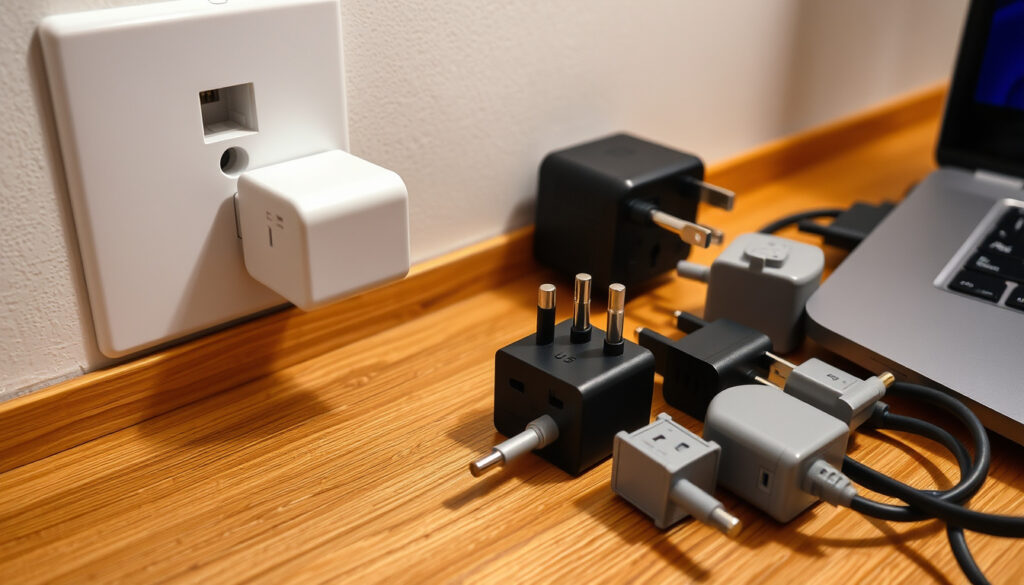
What is a Travel Adapter? Guide to Adapter vs Charger vs Converter
A few hours before a trip, most of us have stood in front of a drawer wondering whether that plastic plug thing we bought years ago actually does anything besides change the shape. It does — but only half the job. A travel adapter solves the geometry problem of fitting your plug into a foreign socket, yet it leaves the electrical voltage completely unchanged.
Worldwide plug types: 15 ·
Countries using 230V: ~200 ·
Devices requiring voltage conversion: ~20% ·
Universal travel adapter sales growth (2024): +12% YoY ·
Most common travel adapter type in Ireland: Type G (UK plug)
Quick snapshot
- Changes plug shape to fit foreign outlets (Wirecutter)
- Does not change voltage (Wirecutter)
- Available as single-type or universal (Wirecutter)
- Adapter: mechanical connection only (World Standards)
- Charger: electronic power conversion (World Standards)
- Many chargers are dual-voltage (World Standards)
- Boots, Harvey Norman, DID
- Screwfix, Argos
- Online: Amazon, Boots.ie
Five key facts, one pattern: the right adapter depends less on the device and more on the destination’s electrical system.
| Fact | Value |
|---|---|
| Number of plug types worldwide | 15 |
| Countries using 230V | ~200 |
| Devices that can use travel adapter only | Most modern electronics |
| Devices needing voltage converter | Hair dryers, older appliances |
| Average price of universal travel adapter (€) | €15–€25 |
What is a travel adapter?
A travel adapter is a small plastic-and-metal accessory that changes the physical shape of your plug so it fits into a wall socket in another country. That’s all it does. It does not change the electrical voltage, the frequency, or the current flowing to your device — it’s a purely mechanical bridge. According to Electrical Safety First (UK electrical safety charity), Ireland uses Type G sockets with three rectangular pins, while the International Electrotechnical Commission recognizes 15 plug types (A through O) used across different regions.
How a travel adapter works
- Your device’s plug inserts into the adapter’s input side.
- The adapter’s output pins match the destination country’s socket shape.
- No electrical conversion happens — voltage passes through unchanged.
The implication: an adapter solves a geometric puzzle, not an electrical one. If your device expects 110V and the wall delivers 230V, the adapter will happily let the higher voltage reach your device. That’s where the real risk lives.
Common types of travel adapters
- Single-type adapters: work in one country or region (e.g., Type G for Ireland and the UK).
- Universal adapters: include multiple prong configurations (typically 4-7 types) in one unit.
- Universal adapters with USB ports: add one or more USB-A or USB-C charging ports but still skip voltage conversion.
As Skyscanner (travel booking platform) puts it, an international travel plug adaptor is a must-have gadget that ensures your devices stay charged wherever you go — provided voltage compatibility is already sorted.
The trade-off: universal adapters cover more ground but are bulkier and sometimes wobble in loose sockets. A dedicated single-type adapter for your destination is smaller and more stable.
A traveler landing in Dublin with a Type G adapter for their phone charger will almost certainly be fine because phone chargers handle 100-240V. That same traveler plugging a 110V hair dryer into the same adapter will watch it burn out within seconds — because the adapter never asked about voltage.
What is the difference between a travel adapter and a charger?
This is the most common confusion among travelers, and the distinction matters. A travel adapter changes the plug’s physical shape; a charger converts incoming AC power into the DC voltage your device’s battery actually needs. They solve completely different problems.
Adapter only changes plug shape
A travel adapter has no electronics inside (unless it includes USB ports). It is a passive mechanical connector. Going In Style (travel accessories retailer) notes that an adapter plug does not change current or voltage — it simply bridges the shape gap between your plug and the wall socket.
Charger converts AC to DC for device battery
A charger contains a transformer and rectifier circuit that converts the alternating current (AC) from the wall into the direct current (DC) your device uses. Most modern smartphone chargers, laptop power bricks, and tablet chargers accept a 100-240V input range, which means they are dual-voltage and work anywhere in the world with just a plug adapter. As Anker (electronics accessories manufacturer) explains, travel adapters are typically sufficient for devices labeled 100-240V, 50/60Hz.
- A phone charger + travel adapter = works globally (most phones).
- A laptop charger + travel adapter = works globally if the power brick is dual-voltage.
- A hair dryer + travel adapter = does not work unless the hair dryer is also dual-voltage (most are not).
Why this matters: Packing a travel adapter but forgetting that your charger is already dual-voltage wastes luggage space. Conversely, assuming your charger works everywhere without checking its label can leave you without power.
Some universal travel adapters include built-in USB charging ports. In that case, the adapter contains a mini charger inside. But the prong side still does no voltage conversion — check the USB output rating (usually 5V/2A) against your device’s requirements.
How do I know if I need a converter or adapter?
This is the decision that separates a successful trip from a fried-device disaster. The answer lives on a small label on your device’s power supply or charger brick.
When a voltage converter is necessary
If your device’s label says 110-120V only (typical for US appliances), then plugging it into a 230V socket via a travel adapter will deliver double the voltage it was designed for. Wirecutter (consumer product review outlet) warns that Europe/UK-style 230V systems mean travelers from 120V countries must check device voltage compatibility before plugging in. For single-voltage devices, you need a step-down voltage converter that transforms 230V to the 110V your device expects.
Devices that typically require converters:
- Hair dryers and curling irons
- Electric shavers (older models)
- Small kitchen appliances (coffee makers, kettles)
- Older phone chargers
Devices that are dual-voltage
Most modern electronics are dual-voltage. Look for the range 100-240V printed on the power supply or device label. World Standards (international electricity standards authority) states that a plug adapter should be used only if the local mains voltage matches your home voltage or the device is multi-voltage. If the label says 100-240V, you’re safe with just a travel adapter in any country.
- Phone chargers: almost always 100-240V
- Laptop chargers: typically 100-240V
- Camera chargers: usually dual-voltage
- Tablets and e-readers: almost always dual-voltage
The pattern: anything with a wall-wart power supply that feels warm and has a USB port is almost certainly dual-voltage. Anything with a heating element (hair dryer, straightener) is almost certainly single-voltage and will need a converter.
What adapter do I need for Prague?
Prague is a frequent destination for Irish travelers, and the answer is straightforward. The Czech Republic uses Type C and Type E sockets, which have two round pins — the classic European socket shape.
Czech Republic plug type (Type C/E)
According to World Standards, Type C (two round pins, no grounding) and Type E (two round pins with a grounding dimple) are standard in the Czech Republic. Most universal travel adapters include a Type C/E pin configuration. If you’re buying a single-type adapter for Prague, look for “Europe” or “Type C/E” on the packaging.
Voltage and frequency in Prague
The standard voltage in the Czech Republic is 230V at 50Hz — identical to Ireland’s standard supply according to Electrical Safety First. This means most Irish travelers visiting Prague can use the same travel adapter they would use at home, as long as their electronics accept 230V.
- Type C and Type E are the plug standards in Prague.
- Voltage is 230V/50Hz — no converter needed for dual-voltage devices.
- USB chargers, phone chargers, and modern laptops work with just a Type C/E adapter.
The implication for Irish travelers: If you have a Type G (Ireland/UK) device, you need a Type G-to-Type C/E adapter. Your voltage is already compatible because Ireland and the Czech Republic both use 230V. No voltage converter required for dual-voltage electronics — and most modern devices already handle the 230V range without issue.
Some older European sockets are recessed into the wall, and bulky universal adapters may not fit flush. A slim Type C/E-only adapter is often more reliable in older Prague hotels than a multi-prong universal unit.
Where can I buy a travel adapter?
If you’re in Ireland and need a travel adapter before your trip, you have plenty of options both in physical stores and online. Prices range from about €5 for a basic single-type adapter to €30 for a universal model with USB charging ports.
Online retailers in Ireland
The widest selection is available online. Skyscanner recommends buying ahead of travel rather than at the airport, where prices are highest. Key online options:
- Amazon.ie — wide range of universal adapters from €8 to €30
- Boots.ie — travel essentials section with basic and universal adapters
- HarveyNorman.ie — electronics department carries universal travel adapters
- DID.ie — electrical store with adapter options
Physical stores in Ireland
If you prefer to buy in person, these retailers stock travel adapters:
- Boots — nationwide, basic travel adapters near the travel accessories section
- Harvey Norman — larger stores carry universal adapters with USB ports
- DID Electrical — multiple locations with travel power accessories
- Screwfix — sells travel adaptors for power tools and general travel
- Argos — budget-friendly options available for same-day collection
The trade-off: Buying in a physical store lets you check the plug compatibility and build quality before purchase. Online offers better prices and more variety, but you need to verify the adapter supports your destination’s plug type and voltage range.
Travel adapter vs charger vs converter: how to choose
Three devices, three jobs. One common mistake. Here’s the comparison that clears up the confusion once and for all.
Three products, one key difference: only one of them changes voltage — and that’s the one most travelers ignore until it’s too late.
| Feature | Travel Adapter | Charger | Voltage Converter |
|---|---|---|---|
| Main function | Changes plug shape | Converts AC to DC | Steps voltage up/down |
| Electronics inside | None (passive) | Transformer + rectifier | Transformer or solid-state |
| Changes voltage? | No | No (outputs DC) | Yes (e.g., 230V → 110V) |
| Dual-voltage compatible? | Always (mechanical only) | Check label (100-240V) | N/A (does the conversion) |
| USB ports? | Some models | Yes (USB output) | Rare |
| Weight | 20-80g | 30-200g | 200g-2kg |
| Typical price (€) | €5-€25 | €10-€50 | €20-€80 |
| Needed for? | Changing socket shape | Charging device battery | Running 110V devices on 230V systems |
The pattern: most travelers actually need only a travel adapter because their chargers are already dual-voltage. The voltage converter is a specialized tool for appliances with heating elements or motors that are single-voltage. Packing a converter when you only need an adapter adds bulk and cost; skipping a converter when you need one risks destroying your device.
Travel adapter specifications: what the numbers mean
When shopping for a travel adapter, the packaging lists specs that can feel cryptic. Here’s what each one actually tells you. For a more in-depth look at adapter specifications, check out this guide to glass water bottles.
Eight specs, one editorial take: the input voltage range is the single most important number — everything else is about convenience and safety.
| Specification | What it means |
|---|---|
| Plug type support | Which countries’ sockets the adapter fits (e.g., Type A, C, G) |
| Max rated current (amps) | Maximum current the adapter can safely carry — 2.5A (phone) vs 10A (laptop) |
| Max rated power (watts) | Voltage × max current = max power. Example: 230V × 10A = 2300W. |
| USB output voltage | Usually 5V for standard USB; fast-charge models may offer 9V or 12V |
| USB output current | Standard USB-A: 1A-2.4A. USB-C PD: up to 3A or more. |
| Surge protection | Built-in protection against voltage spikes — desirable for expensive electronics |
| Fuse rating | Internal fuse that trips if current exceeds safe limit types |
| Safety certifications | CE (EU), UKCA (UK), UL (US), etc. — mandatory for legal sale in Ireland |
The implication: An adapter rated for 2.5A will charge your phone but won’t run a laptop that draws 3.5A at 230V. Always check the amp rating against the device you plan to use. For most phone and tablet charging, a basic adapter works. For laptops and multiple devices simultaneously, a higher-rated universal adapter is safer.
How to use a travel adapter safely
Using a travel adapter is simple, but a few precautions prevent damage and ensure safety. Here are the steps every traveler should follow before plugging in abroad.
Step 1: Check your device’s voltage label
Look on the power brick, charger, or device itself for the input voltage range. If it says 100-240V, you’re safe with just an adapter in any country. If it says 110-120V only, you need a voltage converter.
Step 2: Match the plug type to your destination
Use a resource like World Standards or Wise (international money transfer service) to confirm your destination’s plug type and voltage. Ireland uses Type G (230V). Prague uses Type C/E (230V). The US uses Type A/B (120V).
Step 3: Insert the adapter firmly
Loose connections cause arcing and overheating. Push the adapter fully into the wall socket before connecting your device, especially with universal adapters that can be slightly wobbly in some sockets.
Step 4: Check the fuse (if applicable)
Type G plugs (Ireland/UK) include an internal fuse. If your adapter stops working, the fuse may have blown. According to Electrical Safety First, Type G plugs incorporate an internal fuse for extra safety — always carry a spare fuse or a backup adapter for critical devices.
Step 5: Unplug when not in use
Leaving an adapter plugged in overnight with nothing connected is generally safe, but unplugging when not in use reduces wear on the adapter’s pins and prevents any potential overheating from a faulty socket.
The implication: these five steps are simple, but skipping even one — especially the voltage check — is the difference between a charged phone and a ruined trip.
What travel experts say about travel adapters
An international travel plug adaptor is a must-have gadget that ensures your devices stay charged wherever you go.
A travel adaptor provides the converting connection between a native plug type and one of another country.
— Screwfix (hardware retailer)
A plug adapter should be used only if the local mains voltage matches your home voltage or the device is multi-voltage.
— World Standards (international electricity standards authority)
Europe/UK-style 230V systems mean travelers from 120V countries must check device voltage compatibility before plugging in.
— Wirecutter (consumer product review outlet)
The pattern: every expert agrees on one thing — the adapter is only half the equation. Voltage compatibility is the part most travelers overlook, and it is the part that causes the damage.
Summary: the one thing to remember
Here’s the pattern across everything we’ve covered: a travel adapter solves the shape problem, a charger solves the battery problem, and a voltage converter solves the voltage problem. Most travelers need only the first one because their chargers are already dual-voltage. The danger lies in assuming the adapter does more than it does. For an Irish traveler heading to Prague, the answer is a Type C/E adapter and nothing else — your 230V electronics will work as they do at home. For the same traveler heading to the US, you need the same adapter plus a voltage check on every device you plan to plug in. For anyone buying a travel adapter in Ireland, the choice is clear: match the plug type to your destination, confirm your devices are dual-voltage, and never let an adapter be the only thing between your phone and a fried motherboard.
esim.holafly.com, power-plugs-sockets.com, tripofalifestyle.com, wise.com, trip.com, anker.com, vagabondtoursofireland.com, electricalsafetyfirst.org.uk
For a more detailed explanation of plug types and voltage, refer to our travel adapter guide covering international standards.
Frequently asked questions
Can I use a travel adapter for my hair dryer?
Only if the hair dryer is dual-voltage (marked 100-240V). Most hair dryers use 110-120V only and will overheat or burn out on 230V, even with an adapter. If your hair dryer is single-voltage, you need a voltage converter rated for at least the wattage of the dryer (typically 1200-2000W).
Do I need a travel adapter for USB chargers?
USB chargers typically accept 100-240V input, so you need only a plug adapter to change the prong shape to fit the destination’s socket. The USB charger itself handles the voltage conversion.
What is a universal travel adapter?
A universal travel adapter includes multiple prong configurations (usually 4-7 types: Type A/B/C/E/F/G/I) in one device, letting you use it across dozens of countries. Many include USB charging ports, but none convert voltage — always check your device’s voltage compatibility.
Is a travel adapter the same as a power converter?
No. A travel adapter changes plug shape only; a power converter steps voltage up or down. A converter is needed for single-voltage devices when traveling between 110V and 230V regions. An adapter plus a converter is the complete setup for those devices.
Can I charge my laptop with a travel adapter?
Yes, if your laptop charger is dual-voltage (100-240V — most modern laptop power bricks are). Use the travel adapter to fit the destination socket, plug in your laptop charger, and it will work. Check the label on the power brick to confirm.
Will a travel adapter work in all countries?
No. A universal adapter covers most popular destinations (North America, Europe, Asia, Australia), but some countries use rare plug types (Type D in India, Type M in South Africa, Type N in Brazil). Always check your destination’s plug type before buying.
Is it safe to leave a travel adapter plugged in overnight?
Generally yes, if the adapter is from a reputable brand with proper safety certifications (CE, UKCA) and is not overloaded beyond its rated current. However, unplugging when not in use reduces wear and eliminates any risk from a faulty socket.
Do I need a different adapter for iPhone vs Android?
No. Both iPhone and Android phones use standard USB or USB-C charging cables that plug into a USB charger. The USB charger itself is separate from the travel adapter. The same travel adapter works for any device that uses a standard USB charger. As Trip of a Lifestyle (travel blog) notes, phones, tablets, and laptops commonly fall into the dual-voltage category and are usable with an adapter rather than a converter.
Related reading
More related posts
 Te Hapara Fish Shop Gisborne – Menu, Hours & Reviews
 Low Interest Car Finance Ireland 2025: Best Rates & Tips
 All Blacks 2025 Schedule: Full Fixtures, Times & Tour Details
 Rosemary Oil for Hair: Benefits, How to Use, Risks
 Why Donald Trump hasn’t won the Nobel Peace Prize
 Bay of Islands Accommodation: Best Paihia & Kerikeri Stays
 50 Dinner Recipes: Quick, Healthy & Impressive Italian Ideas
 Fisher & Paykel Top Loader: Problems, Lifespan & Review