What is a Voltage Converter? Types, Costs, and When You Need One
Anyone who has packed for Europe with a hair dryer in the suitcase knows the moment: a wall socket that looks foreign and a charger that either handles it or doesn’t, but most of the voltage panic is unnecessary — a device marked 100–240 V needs only the right plug adapter, according to Skyscanner travel booking platform. The real question is simpler than the shelf full of converters suggests: does your device expect American voltage, European voltage, or both?
Common voltages worldwide: 100–240 V (US 120 V, Europe 230 V) · Phone chargers accept: 100–240 V · Typical cost range: $20–$100 · Main types: Step-up and step-down converters
Quick snapshot
- Most European countries use a nominal supply of 230 V at 50 Hz (Electrical Safety First, U.K. electrical-safety charity).
- The U.S. commonly uses approximately 110–120 V, so a single-voltage U.S. appliance faces substantially higher voltage in Europe (Wirecutter, The New York Times product-testing publisher).
- If the label reads 100–240 V, the only missing piece is usually the plug (Skyscanner travel booking platform).
- Whether a device is dual voltage has to be verified on its own label; the device category alone is not proof (Wirecutter, The New York Times product-testing publisher).
- Socket compatibility varies by country, and some outlets won’t accept a basic Type C plug (Maplin, U.K. electronics retailer).
- The adapter-vs-converter decision happens once, at the label check — before you pack, not at the hotel (REI’s World Electricity Guide, U.S. outdoor retailer).
- The socket pattern is stable: Type C is the continental default, with Type G for the UK and Ireland (Maplin, U.K. electronics retailer).
- Dual-voltage devices: pack a plug adapter and skip the transformer (REI’s World Electricity Guide, U.S. outdoor retailer).
- Single-voltage appliances: choose a converter rated above the appliance’s wattage — or leave the device home (REI’s World Electricity Guide, U.S. outdoor retailer).
- U.K. travelers: add a Type G-to-continental adapter to the list (REI’s World Electricity Guide, U.S. outdoor retailer).
Six numbers and letters, one pattern: the input range printed on your device’s label matters more than any destination statistic.
| Spec | Value |
|---|---|
| Standard U.S. voltage | 120 V |
| Standard European supply | 230 V at 50 Hz |
| Phone and laptop chargers | 100–240 V on most modern supplies |
| Continental European plug default | Type C, with E and F common — per Skyscanner’s plug adapter guide, travel booking platform |
| UK and Ireland plug format | Type G |
| Single-voltage device | Needs a converter, not just an adapter |
The pattern is consistent: the destination sets the socket, but only the label sets the voltage answer.
What is a voltage-to-current converter?
Two different devices share a similar name, and the confusion is understandable. Engineers use “voltage-to-current converter” for a circuit that turns a changing voltage signal into a proportional current. Travelers, on the other hand, mean the power device that steps wall voltage up or down.
How the engineering version works
- A voltage-to-current converter translates a changing voltage input into a proportional current output for measurement and control loops.
- It is used in sensors and industrial controls, where a current signal holds up better than voltage over long wiring runs.
What travelers actually mean
In travel shops, a “voltage converter” is not a signal circuit. It’s a transformer-style gadget that converts one wall voltage into another — a very different machine from the sensor component engineers call a V-to-I converter.
A voltage converter or transformer changes electrical voltage, such as stepping European 230 V down to approximately 120 V for a single-voltage U.S. device (Skyscanner travel booking platform).
The implication: when someone asks what a voltage converter is, the useful answer is about the power device — and the first follow-up question is what voltage the gadget expects.
What does a voltage converter cost?
Price in this category tracks wattage more than brand. A converter for a phone and a converter for a hair dryer are different machines with different price tags.
Budget vs. premium models
- Light-duty travel converters for phones, cameras, and laptops typically land between $20 and $50.
- Heavy-duty units rated for hair dryers, curling irons, or travel kettles run roughly $100 and up.
- Wattage headroom, thermal protection, and multiple plug formats push prices toward the top of the range.
Cost breakdown by wattage
- Light loads (chargers, cameras): small units that cost the least and slip into a backpack pocket.
- Medium loads (laptops, camera batteries): mid-range converters with more headroom.
- High loads (heating and motor appliances): heavy transformer boxes at the top of the price range.
The rated wattage matters more than the sticker price. A converter rated for 50 W will not run a high-wattage hair dryer at all, no matter how good the deal looks.
Where to buy
- Travel and luggage chains stock basic converters and adapter sets.
- Electronics retailers carry higher-wattage models with better protection.
- Online marketplaces have the widest range; check the seller and the wattage rating before ordering.
A converter that is too small for the appliance is not a bargain at any price: it can overheat, trip a breaker, or damage the device it was meant to protect.
The trade-off: the $25 converter that fits a phone charger is the right buy; the $25 converter that promises to run a hair dryer is the one that fails exactly when you need it.
What are the types of converters?
Travel converters come in three functional flavors, and the names describe which direction the voltage moves.
Step-down converters
- Reduce 220–240 V to 100–120 V — the type a U.S. traveler needs for a single-voltage device in Europe.
- Built for bringing American appliances into European hotel rooms.
Step-up converters
- Raise 100–120 V to 220–240 V — for running a European appliance in North America.
- Less common for U.S. travelers going to Europe; more relevant for Europeans visiting the U.S.
Universal voltage converters
- Handle both directions with a switch or automatic detection.
- Usually the heaviest and the priciest option in the travel aisle.
Step-down and step-up are not interchangeable: buy the direction that matches the device and the destination, not the cheapest box on the shelf.
The pattern: the direction and the wattage rating are the two specs that decide whether a converter is actually useful — everything else is packaging.
Do I really need a voltage converter?
For most travelers, the honest answer is no — but the caveat is printed on the device’s own label. U.K. readers get the shortest version: the voltage already matches most of Europe, so a converter is rarely the answer — the adapter is what’s missing (Electrical Safety First, U.K. electrical-safety charity).
When chargers are dual voltage
- If the label reads 100–240 V, 50/60 Hz — as noted in the intro — the device is designed for both common international ranges, and the plug adapter is the only missing piece.
- Most phone, tablet, laptop, and camera power supplies fall into this group, but the individual label must be checked rather than assumed.
For a USB-charged travel kit — phone, earbuds, camera, power bank — the converter stays home and the adapter goes in the bag.
Which devices need clean output
- Motors, timers, and some audio equipment can be picky about the output a cheap converter produces.
- For a resistive load like a hair dryer, the waveform matters less than the wattage rating and the heat protection.
Hair dryers and curling irons
- A device labeled only 120 V or 110–120 V is not automatically safe on a 230 V European supply — it may require a suitable converter or a European-voltage replacement (Skyscanner travel booking platform).
- Heating appliances draw enough power that a low-wattage converter simply won’t handle them; match the converter’s rating to the appliance’s wattage.
- Clocks and motorized appliances can be sensitive to Europe’s 50 Hz frequency even when the voltage is converted.
If the label shows a single voltage, the safe move is a converter rated above the appliance’s draw — or a European-voltage version of the same appliance.
What this means: the entire “do I need it” question collapses into one label check — 100–240 V means adapter only; a single voltage means a converter or a different device.
What’s the difference between a voltage converter and a travel adapter?
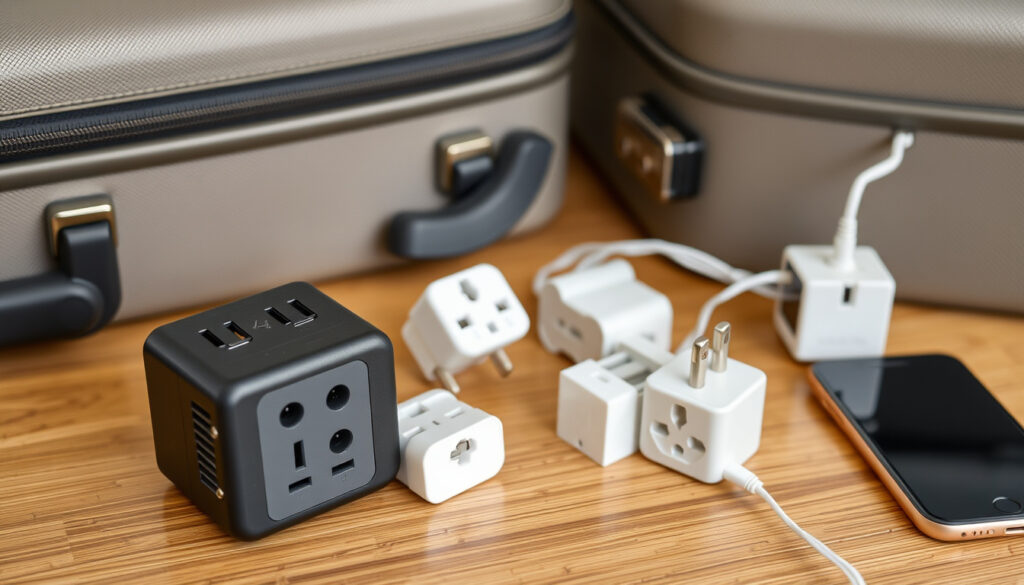
This is where most of the confusion lives, and the difference is simple: adapters fix the socket, converters fix the voltage.
Plug shape vs electrical voltage
- A plug adapter changes the physical shape of a plug so it fits a foreign socket; it does not change voltage or frequency (Wirecutter, The New York Times product-testing publisher).
- A voltage converter changes the voltage itself — the step-up/step-down device described in the first section — so it solves a different problem entirely.
Socket compatibility by destination
- Travelers from the United Kingdom need a plug adapter for continental Europe because British Type G plugs do not fit common continental sockets (REI’s World Electricity Guide, U.S. outdoor retailer).
- U.S. travelers need an adapter for continental Europe because Type A/B plugs differ from European formats; the socket table below shows the regional pattern.
- Many devices need only an adapter in Europe; the converter enters the picture only when the device label shows a single voltage.
Do you need both?
- Dual-voltage device + European socket = adapter only.
- Single-voltage device + European socket = a converter, and often an adapter too.
- Dual-voltage device with a U.S.-style plug = still needs the adapter, even if the voltage is fine.
The catch: some products sold as “adapters” actually contain a converter, so read the box for the words “step-down” before you assume a simple plug adapter is all you’re buying.
Six socket systems, one pattern: the closer you get to the Type C default, the simpler the adapter — and Type G makes the UK its own case.
| Destination | Socket types | Note |
|---|---|---|
| Most of continental Europe | Types C, E, F | Common continental pattern (Maplin, U.K. electronics retailer) |
| France | Types C, E | Works with most universal adapters (REI’s World Electricity Guide, U.S. outdoor retailer) |
| Germany, Greece, Netherlands, Portugal, Spain, Croatia | Types C, F | Widely used continental standard (REI’s World Electricity Guide, U.S. outdoor retailer) |
| Italy | Types C, F, L | Type L outlets need a dedicated adapter (REI’s World Electricity Guide, U.S. outdoor retailer) |
| United Kingdom and Ireland | Type G | Three-pin standard, different from the continent |
| How to check your own device | Read the Input line | 100–240 V = adapter only; single voltage = converter needed |
Voltage converters: the upsides and downsides
Upsides
- Makes a single-voltage U.S. appliance usable on Europe’s 230 V supply.
- Cheaper than replacing a good appliance with a European-voltage version.
- The only way to run high-wattage items like a hair dryer that isn’t dual voltage.
Downsides
- Adds weight: high-wattage converters are heavy transformer boxes, not pocket gadgets.
- Does nothing for plug shape — you still need the correct adapter.
- Typically $20 to $100+, and a mis-sized converter can overheat or damage the device.
- Frequency-sensitive devices (clocks, some motors) can still misbehave on 50 Hz.
The trade-off: a converter replaces one problem (wrong voltage) with a new set of constraints (weight, cost, heat) — so it earns its place only when the device is truly single voltage.
What we know vs what’s still unclear
Confirmed facts
- Phone, tablet, laptop, camera, and rechargeable-device power supplies are commonly marked for 100–240 V input, but the individual label must be checked rather than assumed (Wirecutter, The New York Times product-testing publisher).
- Converters change voltage; adapters change plug shape. They are not the same tool (Skyscanner travel booking platform).
What’s unclear
- Whether a specific appliance is dual voltage can’t be inferred from its brand or category — only its label answers that.
- Which socket types you’ll actually meet: most of continental Europe uses Type C, E, or F, but compatibility varies by country.
- Whether a low-cost converter delivers clean enough power for motors, timers, or sensitive electronics.
The takeaway: the confirmed list is short but practical, and the unclear list is exactly where travelers waste money — by guessing instead of reading the label.
What the experts say
Two pieces of guidance show up again and again in travel-power advice, and both point the same direction: check the standard, then pack accordingly.
Most European countries use a nominal supply of 230 V at 50 Hz.
Most continental European countries use Type C, E, or F plug systems, although socket compatibility varies by country.
— Maplin, U.K. electronics retailer
The pattern: the voltage standard is not the threat travelers imagine — the socket mismatch is, and a small adapter set answers it.
The whole category exists because the world never agreed on one wall voltage. That’s not a reason to carry a transformer for every trip — it’s a reason to read one line on each device label. For the traveler heading to Europe with USB-charged gear, the decision is clear: check the input range once, pack a plug adapter, and leave the converter at home — or buy a properly sized step-down unit for that single-voltage hair dryer you refuse to travel without.
Frequently asked questions
Can I use a hair dryer in Europe with just an adapter?
Only if the dryer’s label says 100–240 V. Most single-voltage hair dryers are made for 120 V and need a step-down converter rated above the dryer’s wattage; an adapter alone does not change the voltage.
Is a voltage converter the same as a transformer?
In travel products, the terms are usually used interchangeably. Both describe a device that steps voltage up or down — the difference is marketing language, not function.
What is the best voltage converter for 220V appliances?
For a 120 V U.S. appliance running on 220–240 V European power, choose a step-down converter with wattage headroom above the appliance’s draw. The best option is the one rated for your specific device, not the most expensive box on the shelf.
Do I need a converter for a CPAP machine in Europe?
Check the power supply label first. Many CPAP power supplies are dual voltage (100–240 V) and only need a plug adapter; if the label says 120 V only, you’ll need a converter rated for the machine’s wattage.
How do I know if my device is dual voltage?
Look for the Input line on the power supply or device label. If it reads 100–240 V, 50/60 Hz, the device is dual voltage. If it lists a single voltage such as 120 V, it is not.
Are travel converters safe for all electronics?
No. A converter must be sized for the appliance’s wattage, and some electronics — motors, clocks, sensitive audio gear — can misbehave on converted 50 Hz power. Read both labels: the device’s and the converter’s.
Can I run a 110V device on 220V without a converter?
Not safely. If the label says 120 V or 110–120 V only, the higher European voltage can damage the device. A step-down converter, or a European-voltage version of the device, is the safe route.
Related reading
- Planning the flight part of the trip: Flights from Auckland to London guide.
- Heading the other way: Auckland to Delhi flight guide.
More related posts
 Ivermectin Chemist Warehouse NZ: Prescription, Uses & Availability
 Dana White Net Worth 2025: Forbes Estimates Over $600M
 Best Mexican Food Near Me: Find Local Favorites Open Now
 Street Fighter Movie 2026: Cast, Release Date, and Updates
 McDonald’s Drive-Through Parking Ticket: Do You Have to Pay
 What Is Beef Tallow – Guide to Benefits, Uses and Nutrition
 Build-A-Bear Sylvia Park: Hours, Prices & Age Policy