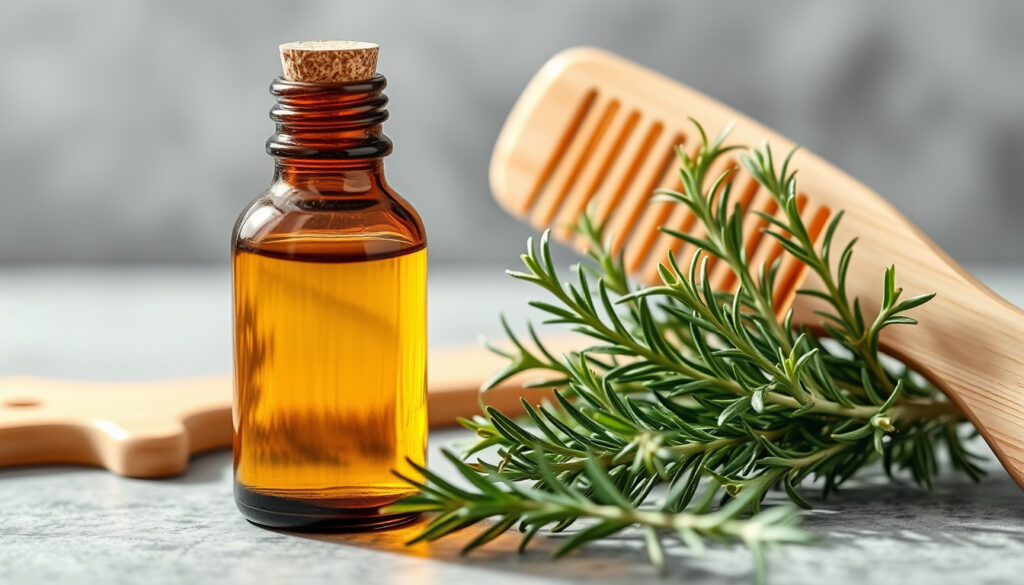
Rosemary Oil for Hair: Benefits, How to Use, Risks
There’s a reason so many people are swapping leave-in conditioners for rosemary oil — the science is catching up, with evidence ranging from stimulating circulation to potentially competing with minoxidil. This guide separates the fact from hype, explains how to use it correctly, and compares it with coconut oil so you can decide what works for your hair.
Benefit for hair strength: Rosemary oil helps strengthen hair and reduce breakage (Boots) ·
Scalp benefit: Soothes irritated scalp and reduces dandruff (Holland & Barrett) ·
Growth stimulation: Improves scalp circulation to encourage thicker hair (Tisserand) ·
Grey hair delay: May help delay onset of grey hair (Holland & Barrett)
Quick snapshot
- Rosemary oil has antimicrobial and anti-inflammatory properties (PMC review)
- Traditional use for hair growth documented across cultures (Cleveland Clinic)
- Some clinical studies show efficacy comparable to minoxidil (PMC review)
- Exact mechanism of hair growth stimulation (Healthline)
- Long-term safety of daily application (GoodRx)
- Efficacy across different hair types and conditions (Healthline)
- No established timeline for results; varies by individual (Cleveland Clinic)
- Some studies show improvement after 6 months of consistent use (PMC review)
Eight key facts about rosemary oil for hair, from its scientific identity to the evidence behind the claims.
| Fact | Value | Source |
|---|---|---|
| Scientific name | Rosmarinus officinalis | PMC review (NIH database) |
| Key active compound | 1,8-cineole | PMC review (NIH database) |
| Common dilution ratio | 2–3 drops per tablespoon of carrier oil | GoodRx (healthcare resource) |
| Evidence level for hair growth | Comparable to 2% minoxidil in one 6-month trial | Cleveland Clinic (nonprofit medical centre) |
| Antioxidant property | Protects hair follicles from oxidative stress | Healthline (health information publisher) |
| Anti-androgenic effect | May block DHT, reducing follicle miniaturisation | PMC review (NIH database) |
| Skin safety | Must be diluted; may cause irritation if undiluted | GoodRx (healthcare resource) |
| FDA status | Not approved as a hair growth medication | Ethique (sustainable cosmetics brand) |
Does rosemary oil help in hair growth?
The short answer: evidence suggests yes, especially for androgenetic alopecia (pattern hair loss). A randomized comparative trial found that rosemary oil performed about as well as 2% minoxidil after six months, with the added benefit of less scalp itching (Cleveland Clinic). The proposed mechanisms include improved scalp circulation, anti-inflammatory action, and anti-androgenic effects that may block DHT (PMC review).
Which oil is no. 1 for hair regrowth?
No single oil holds a universal top spot, but rosemary oil is often cited as the leading natural option. The 2023 review of natural alternatives highlighted rosemary oil as one of the more promising choices for hair loss (Ethique). In a compound treatment group, one study reported a 79% increase in hair growth compared with 41% for 5% minoxidil and 13% for placebo (PMC review). For medical-grade results, minoxidil remains the pharmaceutical standard, but rosemary oil offers a gentler alternative.
What are the big 3 for thinning hair?
The “big three” typically refer to minoxidil, finasteride, and ketoconazole shampoo. Rosemary oil is not part of that clinical trio, but it’s increasingly used as a complementary or alternative natural agent. Unlike finasteride, rosemary oil doesn’t carry the risk of sexual side effects (Cleveland Clinic). If you’re experiencing bleeding after sex, you can find more information on its causes and care at $Bleeding after sex causes.
What are the before and after results of using rosemary oil for hair growth?
Users and small studies report visible thickening and reduced shedding after 3–6 months of consistent use. The 2025 Rosmagain study noted that rosemary-lavender and rosemary-castor oil blends significantly improved hair growth rate, thickness, density, length, and reduced hair fall compared with coconut oil alone (PMC article on Rosmagain). Results vary by individual, and patience is key.
For Irish shoppers considering rosemary oil as a minoxidil alternative, the clinical data is encouraging but not conclusive. The biggest trade-off: you need months of discipline to see results, and the evidence base is still thinner than what exists for pharmaceutical treatments.
How do you use rosemary oil on your hair?
Getting the application right is critical — undiluted essential oil can irritate the scalp. Here’s the step-by-step method recommended by dermatologists and verified by multiple sources.
- Choose a carrier oil. Mix 2–3 drops of rosemary essential oil with 1 tablespoon of a carrier oil such as coconut, jojoba, or olive oil (Cleveland Clinic).
- Apply to the scalp. Part your hair and massage the oil blend directly into the scalp for 2–3 minutes. Focus on areas of thinning (GoodRx).
- Leave it in. Allow the oil to sit for at least 30 minutes. For
More related posts
 NZD to Pound Sterling Exchange Rate: Convert, Forecast & History
 ABC News Australia: Ownership, Bias, Staff Strikes and Facts
 New Zealand Dollar to USD: Live Rate, Forecast & Guide
 Lord of the Rings Books: Order, Count & Reading Guide
 T&G Global: CEO, Company Profile, and Chat Slang Meanings
 Dana White Net Worth 2025: Forbes Estimates Over $600M
 Time in London Now: Current Local Time, GMT/BST & DST Changes
 Ivermectin Chemist Warehouse NZ: Prescription, Uses & Availability