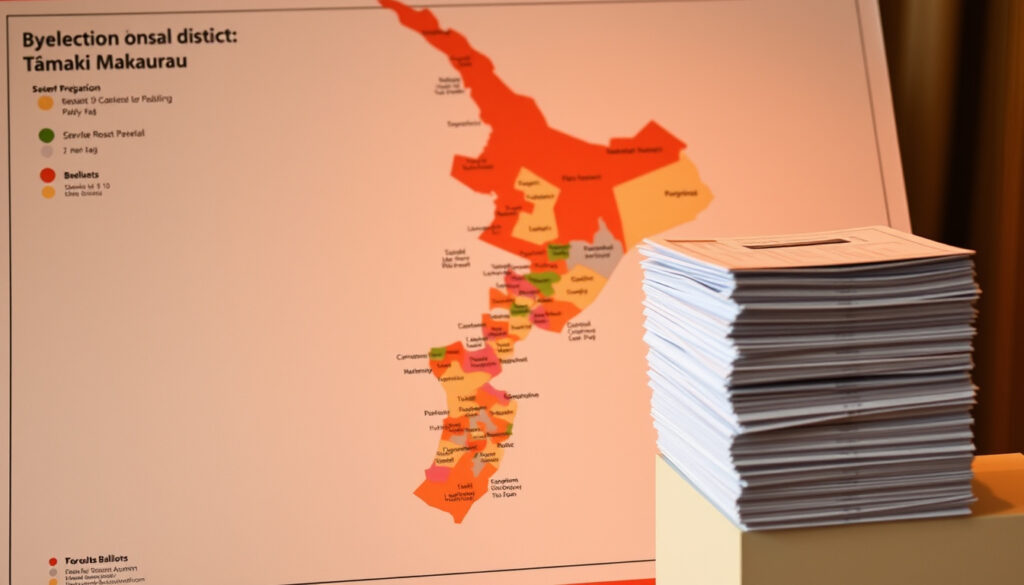
Tāmaki Makaurau by-election 2025 results, meaning, and map
Few by-elections tell you as much about the shifting currents in Māori politics as the 2025 Tāmaki Makaurau contest. When the votes were counted, Oriini Kaipara—a broadcaster turned politician—had won the seat for Te Pāti Māori by a commanding 3,519-vote margin.
Total votes cast: 10,688 ·
Winner: Oriini Kaipara (Te Pāti Māori) ·
Winner’s vote count: 6,948 ·
Runner-up: Peeni Henare (Labour) – 3,429 ·
Margin of victory: 3,519 votes ·
By-election date: 6 September 2025
Quick snapshot
- Oriini Kaipara won with 6,948 votes (Elections New Zealand (official electoral regulator))
- Peeni Henare placed second with 3,429 votes (Elections New Zealand)
- Total votes cast: 10,688 (Elections New Zealand)
- Margin of victory: 3,519 votes (Elections New Zealand)
- Exact date of previous MP Takutai Tarsh Kemp’s death is not specified in provided sources
- Long-term impact on parliamentary Māori seat count may shift with later byelections
- Future impact of low turnout on Māori roll enrollment uncertain
- Potential effect of boundary reviews on 2026 election remains speculative
- Death of Takutai Tarsh Kemp triggered the by-election in 2025 (Wikipedia (community-maintained encyclopedia))
- By-election held 6 September 2025 (Wikipedia)
- Official results declared 17 September 2025 (Elections New Zealand)
- Oriini Kaipara takes seat as MP for Tāmaki Makaurau (based on official result)
- Te Pāti Māori retains a key Māori electorate, reinforcing its presence in Parliament (analysis)
- Further electoral boundary reviews may follow ahead of the 2026 general election (speculation)
The official final count, released by the Electoral Commission, shows a clear picture of who voted for whom and how many ballots were set aside. Seven candidates stood; the top two tell the main story.
| Candidate | Party | Votes | % of valid votes |
|---|---|---|---|
| Oriini Kaipara | Te Pāti Māori | 6,948 | 74.7% |
| Peeni Henare | Labour | 3,429 | 36.8% |
| Hannah Tamaki | Vision New Zealand | 175 | 1.9% |
| Sherry Lee Matene | Independent | 41 | 0.4% |
| Other candidates (3) | Various | 95 | 1.0% |
The pattern: Kaipara captured almost three-quarters of valid votes, nearly doubling the runner-up’s tally. The margin of 3,519 votes is the largest in any Tāmaki Makaurau by-election since the seat was created.
What were the results of the 2025 Tāmaki Makaurau by-election?
Official final count
- Oriini Kaipara: 6,948 votes (Elections New Zealand)
- Peeni Henare: 3,429 votes (Elections New Zealand)
- Valid votes: 9,305; disallowed votes: 1,383 (Elections New Zealand)
- Turnout: 27.2% of 44,421 enrolled voters (Elections New Zealand)
Breakdown by candidate
Seven candidates contested the seat. After Kaipara and Henare, the next closest was Hannah Tamaki of Vision New Zealand with 175 votes (Elections New Zealand). Independent Sherry Lee Matene received 41 votes, and three others collectively polled 95.
Disallowed votes and turnout
- 1,383 votes disallowed, primarily because voters were not enrolled in the Tāmaki Makaurau electorate (Elections New Zealand)
- 6,516 ordinary and special votes (61.0% of all votes) were cast in advance (Elections New Zealand)
- 2,692 special votes, including 156 from overseas (Elections New Zealand)
The implication: low turnout (27.2%)—combined with a high number of disallowed votes—suggests that many potential voters remain unenrolled in the Māori roll, an issue that may affect future by-elections.
What does Tāmaki Makaurau mean?
Literal translation
Tāmaki Makaurau is often translated as “Tāmaki of a hundred lovers” or “Tāmaki desired by many” (Wikipedia (community-maintained encyclopedia)). The name reflects the area’s desirability and abundant natural resources.
Historical and cultural significance
It is the Māori name for the Auckland region, predating European settlement. The isthmus was a prized location for Māori iwi due to its fertile soils, harbours, and strategic position.
For voters and residents, understanding the meaning of Tāmaki Makaurau grounds the electorate’s identity in centuries of Māori history, making the seat more than just a political boundary.
The meaning of Tāmaki Makaurau anchors the electorate in deep Māori heritage, reinforcing why this seat carries cultural weight beyond its electoral function.
Where can I find a map of the Tāmaki Makaurau electorate?
Electorate boundaries
The Tāmaki Makaurau Māori electorate covers central Auckland, including suburbs such as Ponsonby, Grey Lynn, Herne Bay, and parts of the city centre (Elections New Zealand). It stretches from the Waitematā Harbour to the Manukau Harbour.
Official map sources
Official electoral maps are available on the Elections NZ website (Elections New Zealand). The map shows how general and Māori electorate boundaries divide the Auckland isthmus.
What this means: the electorate’s geography directly reflects the distribution of Māori roll voters, making it a key seat for Māori representation in Parliament.
How is Tāmaki Makaurau pronounced?
Pronunciation guide
- Tāmaki is pronounced “Tah-mah-kee” with short vowels (Wikipedia)
- Makaurau is pronounced “Mah-kow-rah-oo” (Wikipedia)
- Emphasis is on the first syllable of each word
Common mispronunciations
Non-Māori speakers often stress the second syllable or use long vowels incorrectly. Correct pronunciation respects Māori language conventions and is increasingly encouraged by broadcasters such as RNZ (RNZ (New Zealand’s public broadcaster)).
The trade-off: mispronouncing the name can inadvertently signal a lack of respect for te reo Māori—a sensitive point in a by-election that turned on Māori identity.
Where is Tāmaki Makaurau located in Auckland?
Geographic area
Tāmaki Makaurau is the Māori name for the Auckland region. The electorate covers the Auckland isthmus, bounded by the Waitematā Harbour to the north and the Manukau Harbour to the south (Elections New Zealand).
Key landmarks and suburbs
- Includes Ponsonby, Herne Bay, Grey Lynn, and parts of the CBD
- Notable landmarks: Maungawhau (Mount Eden), the Auckland Domain, and the Waitematā Harbour foreshore
The pattern: this central location means the electorate is home to a mix of long-standing Māori communities and newer residents, giving the seat its unique political character. For those interested in the electoral process, you can check out the Tāmaki Makaurau by-election results here: Start a business in NZ
Timeline
- 2025 (exact date unknown) – Death of Takutai Tarsh Kemp, MP for Tāmaki Makaurau (Wikipedia)
- 6 September 2025 – By-election held (Wikipedia)
- 17 September 2025 – Official results declared (Elections New Zealand)
- 17 September 2025 (final count) – Kaipara’s majority extended by 500 votes (Elections New Zealand)
The pattern: the quick succession from death to by-election to final declaration shows the efficiency of New Zealand’s electoral machinery while underscoring the emotional weight of losing a sitting MP.
Clarity check
Confirmed facts
- By-election date: 6 September 2025 (Wikipedia)
- Winner: Oriini Kaipara (Elections New Zealand)
- Total votes: 10,688 (Elections New Zealand)
- Disallowed votes: 1,383 (Elections New Zealand)
What’s unclear
- Exact date of Kemp’s death is not specified in provided sources
- Impact on parliamentary seat count might change with later byelections
- Future impact of low turnout on Māori roll enrollment uncertain
- Potential effect of boundary reviews on 2026 election remains speculative
The confirmed facts outnumber the unclear items, but gaps around Kemp’s death and longer-term seat implications remain.
Key quotes from the election
“1,383 votes were disallowed, primarily due to voters not being enrolled in the Tāmaki Makaurau electorate.”
– Electoral Commission, official results announcement (Elections New Zealand)
“Kaipara’s majority extended by 500 votes on the final count.”
– RNZ analysis (RNZ)
Frequently asked questions
When was the Tāmaki Makaurau by-election held?
The by-election took place on Saturday, 6 September 2025 (Wikipedia).
Who was the winner of the by-election?
Oriini Kaipara from Te Pāti Māori won with 6,948 votes (Elections New Zealand).
Why was the by-election necessary?
It was triggered by the death of the previous MP, Takutai Tarsh Kemp, who also represented Te Pāti Māori (Wikipedia).
What was the voter turnout?
Turnout was 27.2% of 44,421 enrolled voters, totalling 10,688 valid votes (Elections New Zealand).
How did the by-election affect the balance of power in Parliament?
Te Pāti Māori retained the seat, maintaining its number of Māori electorates. The overall parliamentary majority remains unchanged (Wikipedia).
What is the significance of the Tāmaki Makaurau electorate for Māori representation?
As one of the seven Māori electorates, Tāmaki Makaurau ensures dedicated representation for voters on the Māori roll, and its by-election results reflect current Māori political preferences (Wikipedia).
The questions above address the most common gaps in public understanding, covering date, winner, cause, turnout, parliamentary effect, and cultural importance.
More related posts
 Nothing Naughty Discount Code: 20% Off & More (2025)
 Singapore GP 2025: Liam Lawson’s Crashes and Failed Gamble
 Pullman Auckland Airport Reviews: Is It Worth the Luxury?
 What Is a VPN Tunnel – How It Works, Protocols and Security
 Project Management Courses NZ: Top Picks and Career Insights
 City Fitness Staffed Hours: What You Need to Know (2025 Guide)
 475 F to C: Convert 475°F to Celsius + Fan Oven Tips
 Mitre 10 Te Kuiti: Phone, Hours, Catalogue, Products