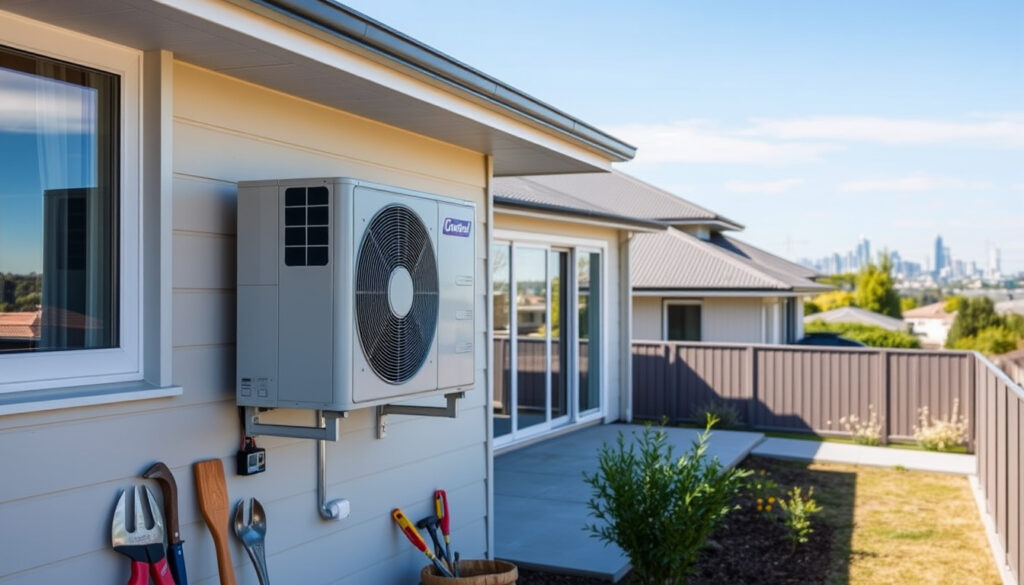
Heat Pump Installation Auckland: Costs, Brands & Fees
Anyone who has called three heat pump installers in Auckland has probably noticed the same thing: the quoted totals can swing by more than a thousand dollars for the same size unit, with Consumer NZ putting the labour component of a standard install at $750–$1,350 (Consumer NZ (independent consumer organisation)), but the final price depends on the brand, the electrician’s fee, and whether your house needs extra work. This guide breaks down the real costs Aucklanders pay, the hidden charges that catch people off guard, and the steps to get a fair deal.
Average Auckland heat pump installation cost: $1,800–$3,500 · Typical labor-only cost: $750–$1,350 · Most common brands installed in Auckland: Mitsubishi, Fujitsu, Daikin · Estimated electrician connection fee: $150–$300 · Average lifespan of a quality heat pump: 10–15 years · Number of verified installers in Auckland region: 50+ certified specialists
Quick snapshot
- Unit + labor: $1,800–$3,500 (GENERAL New Zealand (heat pump manufacturer))
- Labor only: $750–$1,350 (Consumer NZ) (GENERAL New Zealand (heat pump manufacturer))
- Electrician: $150–$300 (ArchiPro (NZ construction platform))
- Mitsubishi Electric (MoneyHub NZ (consumer finance site))
- Fujitsu (MoneyHub NZ) (MoneyHub NZ (consumer finance site))
- Daikin (MoneyHub NZ) (MoneyHub NZ (consumer finance site))
- Get 3 quotes
- Check accreditation
- Confirm consent needs
- Prepare site
- Inspect post-install
- Higher upfront cost (EECA (government energy agency))
- Efficiency drops in cold (EECA (government energy agency))
- Requires annual servicing (EECA (government energy agency))
Five key facts at a glance: what Aucklanders can expect to pay and the usual longevity of the system.
| Label | Value |
|---|---|
| Standard labor cost (Auckland) | $750–$1,350 |
| Average total installed price | $1,800–$3,500 |
| Electrician surcharge | $150–$300 |
| Top-rated brands | Mitsubishi, Fujitsu, Daikin |
| Heat pump lifespan | 10–15 years |
Auckland homeowners who focus on the bottom-line quote without asking what’s included risk paying hundreds extra for electrical work, consents, and after-hours callouts. Always demand an itemised breakdown.
How much does it cost to install a heat pump in Auckland?
What does the quoted price include?
- Most installers in Auckland quote a package that includes the indoor unit, outdoor unit, copper pipes, and standard installation labour. The Fujitsu GENERAL guide says a wall-mounted unit with installation runs $1,500–$4,000 (GENERAL New Zealand).
- Multi-split systems (one outdoor unit powering two or more indoor units) cost $4,500–$8,000+ according to Mr.Cool (Mr.Cool (Auckland installer)).
- Ducted systems, which hide the unit in the ceiling and run ducts to multiple rooms, range from $8,000–$15,000+ (Mr.Cool). OneAir puts the ducted range at $7,000–$20,000+ (OneAir (NZ HVAC retailer)).
Average unit and labor breakdown
Consumer NZ reports the labour component at $750–$1,350 for a standard back-to-back install (Consumer NZ). The unit cost itself varies by brand and capacity. A 6kW hi-wall unit from Snowtemp starts at $3,872 installed (Snowtemp (Auckland HVAC company)). ArchiPro notes that a back-to-back installation can be as low as $900–$2,000 for smaller jobs (ArchiPro). The wide range reflects differences in brand, access, and whether the electrical wiring is ready.
Additional fees to budget for
- Electrician connection: $150–$300, often not included in the base quote (ArchiPro).
- Consent fees: Auckland Council requires building consent for structural alterations; not all installers handle this. The fee can add $200–$600.
- Smart thermostat or zoning: Adds $300–$1,000 (ArchiPro).
- Seasonal premium: Quotes during winter can be 10–20% higher (GENERAL New Zealand).
The pattern: hidden costs often appear where homeowners least expect them.
Which heat pump is best in New Zealand?
Top brands preferred by Auckland installers
- MoneyHub NZ’s 2025–2026 survey places Mitsubishi Electric at the top for reliability, followed by Fujitsu and Daikin (MoneyHub NZ).
- Auckland installers such as Albany Heat Pumps regularly recommend Mitsubishi and Fujitsu for their durability in the local climate (Albany Heat Pumps (Auckland specialist)).
- Daikin is popular for ducted systems and has a strong service network across the North Island.
Key features to compare
Five features, one pattern: the best unit for your home depends on room size, ceiling height, and insulation quality. Look for COP (coefficient of performance) above 4.0, inverter technology for quieter operation, and wi-fi control if you want scheduling. The Energy Efficiency and Conservation Authority (EECA) provides a searchable database of energy ratings to help compare models.
Warranty and servicing considerations
- Mitsubishi Electric offers a 5-year warranty on parts and labour when installed by an approved technician.
- Fujitsu provides a 5-year warranty on the compressor and 3 years on parts.
- Extended warranties can be purchased for around $200–$400 and are recommended for high-usage households.
A cheaper brand may have a lower upfront price but poorer parts availability and shorter warranty. Auckland homeowners who choose an unfamiliar brand might wait weeks for a repair during a cold snap.
What this implies: even the best brand can fail without proper installation and support.
What are the disadvantages of a heat pump?
Higher upfront cost vs. other heating methods
A portable electric heater costs $30–$100, a gas heater $200–$600. A heat pump installation starts at $1,500, so the initial outlay is 5–10 times higher. However, running costs are three to four times lower per unit of heat, because heat pumps move heat rather than generate it (EECA).
Performance in extreme cold
Most standard heat pumps lose efficiency below 0°C. For Auckland, which rarely sees freezing temperatures, this is less of an issue than for South Island homes. Still, during a cold snap, the heat pump may run continuously to maintain temperature, increasing electricity use (GENERAL New Zealand).
Maintenance requirements
- Filters need cleaning every 2–4 weeks in heavy use.
- Professional servicing is recommended every 12 months (cost $150–$250) to maintain efficiency (ArchiPro).
- Neglected units lose 10–15% efficiency per year.
The implication: maintenance is not optional for efficient operation.
How much should labor cost to install a heat pump?
What determines labor rates?
- Accessibility: Units on upper floors or requiring scaffolding add $200–$500.
- Existing wiring: If the house needs a new circuit or upgrade from an old fuse board, labor jumps by $300–$600.
- Consent processing: Not all installers include the time to file paperwork with Council. A $100–$200 fee is common.
Consumer NZ’s $750–$1,350 range covers a straightforward back-to-back installation on a single-storey home with accessible eaves (Consumer NZ).
Typical hourly or fixed price for Auckland
Most Auckland installers charge a fixed project price, not an hourly rate. The fixed price for a standard 3.5kW single-split unit typically falls between $1,700 and $2,800 installed (OneAir). Snowtemp quotes a fixed $3,872 for a 6kW hi-wall unit (Snowtemp).
How to avoid overpaying
- Get at least three itemised quotes that break out unit cost, labour, electrical work, and consent.
- Ask for the installer’s provider number on the Electricians Register — anyone doing electrical work must be registered.
- Check if the quote includes the 6-month free call-back that many quality installers offer.
The catch: a low labour quote may signal hidden fees elsewhere.
Is it worth replacing a boiler with a heat pump?
Running cost comparison (NZ vs UK context)
In New Zealand, central boilers are rare; most homes use ducted or single-split heat pumps. For the minority with a gas or electric boiler (often in older, larger homes), replacing it with a ducted heat pump cuts running costs by 50–70% because heat pumps deliver 3–4 kWh of heat for every 1 kWh of electricity (EECA). The payback period is typically 4–8 years depending on current fuel price.
Installation complexity in Auckland homes
Switching from a boiler to a heat pump usually requires upgrading the electrical panel and installing a new circuit, adding $500–$1,200 to the retrofit cost (ArchiPro). The external unit also needs a concrete pad or bracket, which may require a building consent if the pad extends into the yard.
Environmental and efficiency benefits
- Heat pumps use 80% less electricity than resistive electric heaters for the same heat output.
- If the home has solar panels, the heat pump can run almost entirely on free energy during daylight hours.
- Carbon savings align with New Zealand’s goal to phase out fossil-fuel heating (EECA).
Auckland households that replace an old gas boiler with a ducted heat pump can save $400–$700 per year in fuel costs and reduce their carbon footprint by roughly 1.5 tonnes of CO₂ annually — equivalent to taking a small car off the road.
The implication: switching to a heat pump requires careful planning but offers long-term savings.
Upsides & Downsides of heat pump installation in Auckland
Upsides
- Low running costs — 300–400% efficiency (EECA)
- Provides both heating and cooling
- Improves home value and Healthy Homes compliance
- Available with government subsidies (Warmer Kiwi Homes)
Downsides
- High upfront cost ($1,500–$4,000+)
- Efficiency drops in extreme cold (below 0°C)
- Requires annual professional servicing
- Noise from outdoor unit can be a concern in tight sections
Step-by-step: getting your Auckland heat pump installed without surprises
- Get three itemised quotes — ask for a breakdown of unit, labour, electrical work, and consent. Use the Consumer NZ guide to compare (Consumer NZ).
- Check the installer’s accreditation — look for membership in the Heating and Air Conditioning Institute of New Zealand (HACINZ) and a valid electrical licence.
- Confirm consent needs — Auckland Council requires a building consent if the installation involves structural changes, a new electrical circuit, or a ground-mounted unit within a boundary distance. Ask your installer to handle the process.
- Prepare the site — clear furniture, ensure the outdoor unit location is solid (concrete pad or bracket), and verify drainage paths.
- Inspect post-install — test all functions, check for leaks at pipe connections, and get a written warranty certificate. Most installers offer a 6-month free service check.
The pattern: skipping any of these steps is what leads to the hidden fees and call-back costs that show up in online reviews. A conscientious installer will proactively address consent and electrical work before quoting.
What’s confirmed and what’s still unclear about Auckland heat pump costs
Confirmed facts
- Consumer NZ labor range: $750–$1,350 (Consumer NZ)
- MoneyHub 2026 brand rankings: Mitsubishi, Fujitsu, Daikin (MoneyHub NZ)
- Electrical connection cost: $150–$300 (ArchiPro)
What’s unclear
- Exact average total cost for Auckland sub-regions (West, North Shore, South) — data is not publicly aggregated
- Consent prevalence for heat pump installations — no official Auckland Council count is available
- Exact frequency of after-hours callout fees in Auckland quotes — data not publicly compiled
Quotes from the industry
“A standard back-to-back installation typically costs between $1,500 and $2,500, but homeowners should always get multiple quotes and ask whether electrical work is included.”
— Consumer NZ, independent consumer advice organisation
“For 2025–2026, Mitsubishi Electric and Fujitsu are the top-rated brands for reliability and local support. Don’t buy based on sticker price alone — check warranty and service availability.”
— MoneyHub NZ editor, consumer finance website
“We install mostly Mitsubishi and Fujitsu because they hold up well in Auckland’s humidity and the local distributor has parts on the shelf. A cheap unit might save $300 now but cost you $1,000 in repairs.”
— Albany Heat Pumps, Auckland-based installation specialist
For Auckland homeowners, the implication is clear: the brand you choose is only as good as the installer’s after-sales support. A national brand with a local agent beats an imported brand with no NZ office.
Frequently asked questions
How long does a heat pump installation take in Auckland?
Most single-split installations take 3–6 hours. Ducted systems may take 1–3 days. Multi-split or complex electrical work adds time. Seasonal demand (winter) can push wait times to 2–4 weeks.
Do I need a building consent for a heat pump in Auckland?
Usually not for a simple back-to-back wall-mounted unit. A building consent is required if the installation involves structural modifications, a new electrical circuit, or a ground-mounted unit within 1m of a boundary. Your installer should confirm with Auckland Council.
Can I install a heat pump myself in New Zealand?
No. Electrical work must be carried out by a licensed electrician under the Electricity Act. DIY installation is illegal and voids the warranty. Unauthorised work also risks invalidating your home insurance.
How often should I service my heat pump in Auckland?
At least once a year. Professional servicing includes cleaning coils, checking refrigerant levels, and inspecting electrical connections. Filter cleaning should be done every 2–4 weeks during heavy use.
What size heat pump do I need for a standard Auckland home?
For a typical 40m² open-plan living area, a 3.5–5kW unit is adequate. An 8kW ducted system covers a multi-room area up to 120m². A load calculation by the installer is essential — oversized units short-cycle and lose efficiency.
Are there any rebates for heat pump installation in NZ?
Yes. The Warmer Kiwi Homes programme offers a grant covering up to 30% of the installation cost for low-income owner-occupiers. Check eligibility at EECA.
For Auckland homeowners, the choice is clear: invest in a quality installation with a reputable brand and a fixed-price, all-inclusive quote, or risk higher long-term costs from cheaper alternatives that hide electrical, consent, and service fees. The upfront premium buys reliability, lower running costs, and a warmer winter — every time.
More related posts
 Penman House Demolition Auckland: Location, Timeline & Controversy
 Best Bang Bang Chicken Salad Recipe (Easy & Healthy)
 What Day is Anzac Day? Date, History & Traditions
 Certificate of Entitlement UK: Cost, Validity, and How to Apply
 Best USB-C Car Charger for Fast iPhone and Android Charging
 Home Loan Rates Drop: Will They Fall to 3%? | 2025 Predictions
 Best Coffee in Queenstown: Top Cafés & Local’s Guide
 Australian Dollar to NZ Dollar: Rate, Fees & Forecast 2025