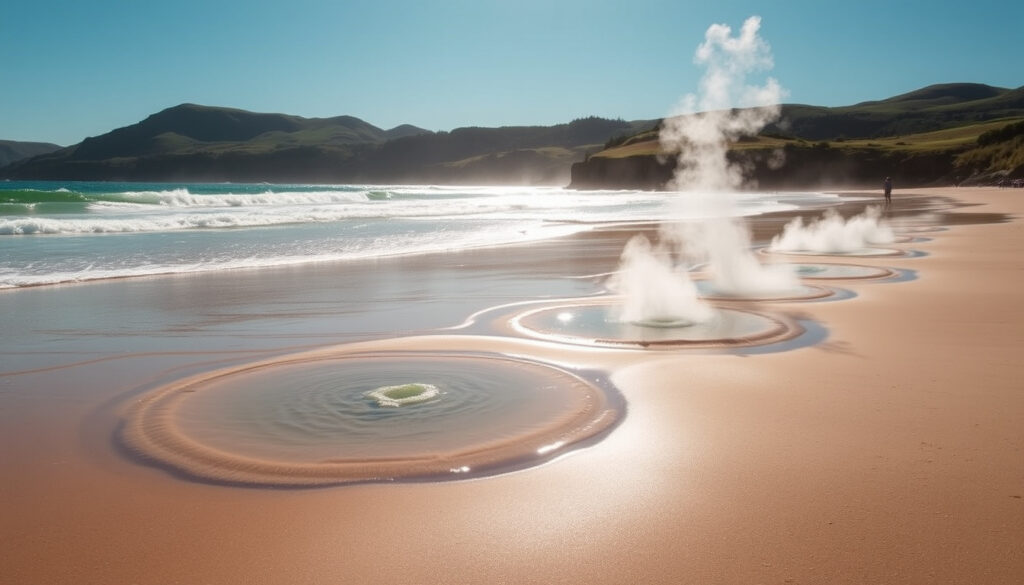
Hot Water Beach Taupo: Free Geothermal Pools Guide
If you’ve heard of Hot Water Beach in the Coromandel but never realized there’s a quieter version right on Lake Taupo, you’re not alone. Many travellers drive past Waipahihi Bay without knowing they can dig their own geothermal pool in the sand, completely free, with parking just steps away. This guide cuts through the comparisons so you know exactly what you’re getting — and what you’re not.
Location: Waipahihi Bay, Lake Taupo · Entry Fee: Free · Activity: Dig geothermal hot pools in sand · Water Source: Natural geothermal springs · Scale: Smaller than Coromandel version
Quick snapshot
- Free public access with no entrance fee (Love Taupo)
- Geothermal springs surface in the sand at Waipahihi Bay (Love Taupo)
- Suitable for visiting year-round (Love Taupo)
- Exact best visiting times for optimal warmth
- Whether fishing is permitted at the beach
- Typical crowd levels at peak hours
- Steam rises from natural hot springs in the sand (Love Taupo tourism site)
- Dig your own pool just steps from the car park (Love Taupo tourism site)
- Lake views while you soak — no crowds fighting for spots (Love Taupo tourism site)
- Not ocean swimming — it’s lake water that you mix yourself (Love Taupo)
- Water can be very hot; supervise children closely (Love Taupo)
- Bring a small shovel or trowel for digging (Love Taupo)
A comparison of the two New Zealand hot water beach destinations reveals stark differences in cost, accessibility, and visitor experience.
| Attribute | Detail |
|---|---|
| Official Name | Taupō Hot Water Beach |
| Location | End of town beach, Waipahihi Bay, Lake Taupo |
| Access Point | Great Lake Pathway, near Steaming Bean coffee cart |
| Operator | Public access — no entry fee |
| Facilities | Parking nearby, toilets within walking distance |
| Best For | Families, budget travellers, anyone already in Taupo |
Is Hot Water Beach Worth It?
Whether this spot earns a place on your itinerary depends entirely on what you’re after. If you’re already in Taupo and looking for a free, low-fuss geothermal experience, Waipahihi Bay delivers exactly that — steam rising from the sand, warm water pooling around you, and views across Lake Taupo without fighting for space. The Love Taupo tourism site describes it as a laid-back alternative to its famous Coromandel cousin, and that framing holds up.
Pros and cons of visiting
Upsides
- Free entry and free parking — no pay-and-display like Coromandel
- No tidal timing needed; you can dig pools any time of day
- Car park is steps from the beach, not a long walk away
- Year-round access — Love Taupo confirms it’s suitable in every season
- No hazardous surf or dangerous rips — lake swimming is gentler than ocean
- Visitors consistently describe it as uncrowded and easy-going
Downsides
- Smaller scale than Coromandel — less dramatic hot water volume
- No lifeguard patrol; you supervise yourself and any children
- Lake setting lacks the ocean drama of the Coromandel version
- Fishing regulations at this exact location remain unclear
- Some visitors who’ve experienced both say Coromandel has more “wow” factor
Taupo’s geothermal spots have no crowds taking up prime spots — a direct contrast to Coromandel, where visitors report arriving two hours before low tide only to find every hot patch already occupied. If you value space and simplicity over dramatic scale, Waipahihi Bay wins.
Comparisons to Coromandel Hot Water Beach
The Coromandel version sits on an ocean beach, which means the hot springs are only accessible during low tide — and visitors must time their arrival within a two-hour window around low tide to access the thermal vents, according to Hauraki Coromandel Tourism. Water temperatures there reach up to 64°C, and hazardous surf with dangerous rips makes swimming risky for anyone not a strong swimmer. Regional lifeguards patrol from December to February, with volunteer weekend patrols from Labour Weekend to Easter.
Coromandel Hot Water Beach is roughly a 2 hour 20 minute drive from Auckland and 30 minutes from Whitianga, according to 100% Pure New Zealand tourism. Its main car park operates on a pay-and-display basis, though Hauraki Coromandel Tourism notes carparks were recently expanded. Limited free street parking exists beyond the main lot.
Taupo, by contrast, offers free all-day parking in town centre streets. Taupō District Council lists Heuheu St with 145 spaces, Taniwha St with 73 spaces, Robert St with 60 spaces, and Tuwharetoa St with 90 spaces — all free, all-day. Time limits apply in some town centre zones and parking is enforced.
For visitors already based in Taupo, driving two hours to Coromandel for a crowded hot spring may not make sense when a quieter version sits at the end of town. But for those planning a Coromandel road trip, the ocean setting and higher water temperatures deliver a different — and arguably more memorable — experience.
Can You Swim at Hot Water Beach NZ?
This question matters more than it might seem, because “swimming” at these geothermal beaches isn’t like swimming at a normal beach. At Waipahihi Bay, you’re working with geothermal water that seeps into the lake, and you create your own pools by digging into the sand. The result is a warm bath, not a swim.
Swimming conditions in Taupo
Lake Taupo’s water temperature varies by season, but the geothermal springs create pockets of warmth right at the waterline. Unlike Coromandel — where the ocean and hot springs interact in a tidal zone — Taupo’s setup is simpler: find a warm patch, dig, let the hot water pool, then mix with cooler lake water to reach a comfortable temperature. You’re not swimming laps; you’re sitting in a self-dug hot tub with lake views.
The Love Taupo site notes the water can be very hot in some places, with caution specifically advised for young children. There’s no lifeguard patrol here — safety is your responsibility.
Safety tips for hot pools
Coromandel’s water reaches up to 64°C at maximum, with typical surface temperatures between 40-60°C according to Hauraki Coromandel Tourism. Taupo’s thermal patches are similar in character, though specific temperature measurements for Waipahihi Bay aren’t publicly documented. The practical rule: test the water with your hand or foot before lowering yourself in. Dig your pit deep enough that you can blend hot and cool water. Children should be supervised at all times, and anyone feeling dizzy or unwell should exit immediately — the high mineral content and temperature make extended soaking inadvisable for some people.
Unlike Coromandel, where lifeguards patrol from December to February and weekends from Labour Weekend to Easter, Taupo has no formal safety presence. Visitors who bring children or have mobility concerns should factor this in — the experience is relaxing, but so is the responsibility.
Do You Have to Pay at Hot Water Beach?
Short answer: no, not at Taupo. Entry is free, and the beach is publicly accessible.
Entry and parking fees
No entry fee exists at Waipahihi Bay. Parking is available in nearby streets — Taupō District Council provides free all-day parking in town centre areas, with Heuheu St offering 145 spaces, Taniwha St offering 73 spaces, Robert St offering 60 spaces, and Tuwharetoa St offering 90 spaces. The beach car park operates with time limits and enforcement.
Compare this to Coromandel, where the main car park is pay-and-display, 24-hour, according to Hauraki Coromandel Tourism. Some visitors report tight parking conditions at Coromandel during peak periods, with limited free street parking beyond the main lot. Tripadvisor visitor reviews often advise arriving early for low-tide visits.
Free access details
The access point for Taupo Hot Water Beach is the Great Lake Pathway, which runs along the lakefront. Love Taupo notes it’s a short stroll from the Steaming Bean coffee cart — a useful landmark if you’re navigating on foot or by bike. No booking is required, no gate stands between you and the sand.
What Is Special About Hot Water Beach?
What makes any hot water beach worth visiting is the rarity of the experience — natural geothermal springs that surface in the sand, allowing you to carve out a personal spa right on the shoreline. At Waipahihi Bay, this experience comes without the crowds, the parking fees, or the tidal calculations.
Geothermal features
The hot water at Taupo rises from natural geothermal springs beneath the sand. Love Taupo describes it as an “incredible slice of lake frontage where you can enjoy steaming hot water straight from a natural geothermal spring.” On cooler mornings or evenings, you can often see steam rising from patches of wet sand — a clear sign of where to dig.
Water temperatures can be extreme in some patches. Love Taupo specifically warns that caution is advised for young children, as some spots reach temperatures that could cause burns. The practical solution is digging to a depth where you can control the mix of hot spring water and cooler lake water.
Unique Taupo experience
The setting matters here. You’re not just soaking in hot water — you’re doing it with Lake Taupo’s expanse in front of you, often with mountain views in the distance. The Great Lake Pathway runs behind the beach, making this part of a longer walk or bike ride if you want to extend the outing.
One Reddit user who visited both Taupo and Coromandel versions called the Coromandel beach “overrated” and noted they preferred the Taupo experience — a sentiment echoed by multiple Tripadvisor reviewers who’ve done both.
Water temperatures at geothermal beaches can cause burns. Always test with your hand before entering. Children should be watched constantly. If you feel unwell — dizzy, nauseous, overheated — exit the water immediately.
What Is the Best Time to Go to Hot Water Beach?
Unlike Coromandel, where low tide is essential for accessing hot springs, Taupo’s geothermal patches aren’t tidal-dependent. You can visit any time of day and find warm spots — though certain times offer advantages.
Tide and timing tips
Since this is a lake beach, not an ocean beach, the tidal window that governs Coromandel access doesn’t apply. Love Taupo confirms the beach is suitable for visiting year-round, which gives you more scheduling flexibility than the Coromandel version.
Morning visits in summer give you cooler air temperatures while the sand is still warming. Evening visits — particularly on cooler days — can make the steam more visible and the water temperature contrast more noticeable. Summer weekends may bring more visitors, though Waipahihi Bay consistently rates as less crowded than Coromandel.
Crowd avoidance
Love Taupo describes the atmosphere as “laid-back” and “chill” with no crowds — a direct contrast to Coromandel’s famous congestion at low tide. If you want solitude, weekday mornings or non-summer evenings are your safest bets. Peak summer weekends will have more visitors, but the beach is large enough that you shouldn’t struggle to find a warm patch.
How to Dig Your Own Hot Pool
The process at Taupo is straightforward, but a few practical steps make the difference between an awkward puddle and a genuinely comfortable soak.
- Find the beach: Access Waipahihi Bay via the Great Lake Pathway. The Steaming Bean coffee cart is a useful landmark if you’re walking or cycling into the area.
- Bring a tool: A small garden trowel, hand shovel, or even a sturdy stick works. You’re digging into wet sand, so something that can handle moisture and pressure helps.
- Locate warm patches: Walk along the waterline and watch for steam rising from the sand — particularly visible on cooler mornings or after rainfall. Patches closer to the lake edge where water pools naturally tend to have the warmest seepage.
- Dig your pit: Aim for roughly 30–50 cm deep. The depth matters because it determines how much hot water pools before you blend it with cooler lake water. Deeper holes hold more water but take longer to warm.
- Test the temperature: Use your hand or foot before committing your body. Aim for a mix that feels comfortably warm — not scalding. The goal is a balance between geothermal heat and lake temperature.
- Supervise children closely: As Love Taupo warns, some spots can be very hot. Keep kids away from the hottest patches and never leave them unattended.
- Soak and enjoy: Once you’ve found a comfortable temperature, settle in. There’s no time limit, no charge, no lifeguard — just you, warm water, and Lake Taupo views.
At Coromandel, you can hire shovels from local cafes according to 100% Pure New Zealand. At Taupo, you’ll need to bring your own — don’t assume tools will be available on-site.
Confirmed facts
- Free public access
- Geothermal springs surface in the sand
- Lake Taupo location at Waipahihi Bay
- Suitable for year-round access
What remains unclear
- Exact optimal visiting times for warmth
- Fishing regulations at the beach
- Typical peak-hour crowd levels
It’s more laid-back and chill, just how we love it here in Taupō. Unlike its famous Coromandel cousin with the same name, there are no crowds taking up all the prime spots here.
— Love Taupo official tourism site
To me this attraction is a bit overrated (I enjoyed the one at Lake Taupo more).
The water is hot – up to 64 degrees Celsius.
— Hauraki Coromandel Tourism
If you’re in Taupo, the choice is obvious: free parking, no crowds, a workable geothermal soak with lake views. If you’re planning a Coromandel trip, the ocean setting, higher water temperatures, and the drama of tide-dependent access make it worth the drive — but factor in pay-and-display parking, possible crowds, and hazardous surf. Both are legitimate experiences; they’re just aimed at different moods.
Related reading: Bay of Islands Accommodation · St Johns First Aid Course
hotwaterbeachtop10.co.nz, zigzagonearth.com, cathedralcove.co.nz, wanderlog.com, youtube.com, reefresorttaupo.squarespace.com, tripadvisor.co.uk
Lake Taupo visitors digging pools at Hot Water Beach will find it complements other top New Zealand geothermal pools scattered across the North Island.
Frequently asked questions
How do you get to Hot Water Beach Taupo?
Drive to the end of Taupo’s lakefront and access Waipahihi Bay via the Great Lake Pathway. The Steaming Bean coffee cart near the pathway entrance serves as a useful landmark. Park in nearby streets — Taupō District Council lists free all-day options including Heuheu St, Tuwharetoa St, Taniwha St, and Robert St. Time limits apply in some zones and enforcement is active.
Is there parking at Hot Water Beach Taupo?
Yes. The beach car park is within walking distance of the hot spring areas. Additional free all-day parking is available in surrounding streets — Taupō District Council details Heuheu St (145 spaces), Taniwha St (73 spaces), Robert St (60 spaces), and Tuwharetoa St (90 spaces). Compare this to Coromandel’s main car park, which is pay-and-display.
Can you fish at Hot Water Beach Taupo?
Fishing regulations at Waipahihi Bay aren’t clearly documented in public sources. Lake Taupo has specific fishing rules governing season, size limits, and gear — but whether those rules apply directly at this beach’s hot spring area requires checking current regional regulations or contacting Taupō District Council directly.
What should you bring to Hot Water Beach Taupo?
Bring a small shovel or hand trowel for digging pools, sunscreen for summer visits, a towel, and water for hydration. If visiting in cooler weather, a change of clothes. Young children should be supervised closely — Love Taupo warns that water temperatures can be very hot in some patches.
How hot is the water at Taupo Hot Water Beach?
Specific temperature measurements for Waipahihi Bay aren’t publicly documented. Comparable Coromandel sites record surface water between 40–60°C, with deeper holes reaching up to 64°C according to Hauraki Coromandel Tourism. At Taupo, the practical approach is to test the water with your hand before entering and dig deep enough to blend hot and cool water to a comfortable temperature.
Is Hot Water Beach Taupo family-friendly?
Yes, with caveats. There’s no hazardous surf or dangerous rips like Coromandel’s ocean conditions, making lake soaking gentler for children. Facilities include nearby toilets and parking. However, Love Taupo advises caution with young children because some geothermal patches can be very hot. Active supervision is essential.
What are Taupo Baths nearby?
Taupo has several geothermal pool facilities in town — including Love Taupo lists multiple options for paid thermal bathing. These differ from Hot Water Beach in that they’re managed facilities with controlled water temperatures, changing rooms, and often indoor or sheltered options. Hot Water Beach offers a free, natural, DIY alternative.
More related posts
 Wheel of Time Season 4: Cancellation and Future Prospects
 Bed Bath and Beyond New Zealand – Status, Shipping & Alternatives
 50 Dinner Recipes: Quick, Healthy & Impressive Italian Ideas
 Home Loan Rates Comparison NZ: 2025 Best Rates & Repayments
 Hamilton to Palmerston North: Bus, Train, Flights & Drive
 NZ Screen Awards Guest Aggressive: Arrest and Trespass
 Mumbai Indians vs Chennai Super Kings: Dhoni & 2026 Rivalry
 Auckland Houses Under $800,000: A Buyer’s Guide