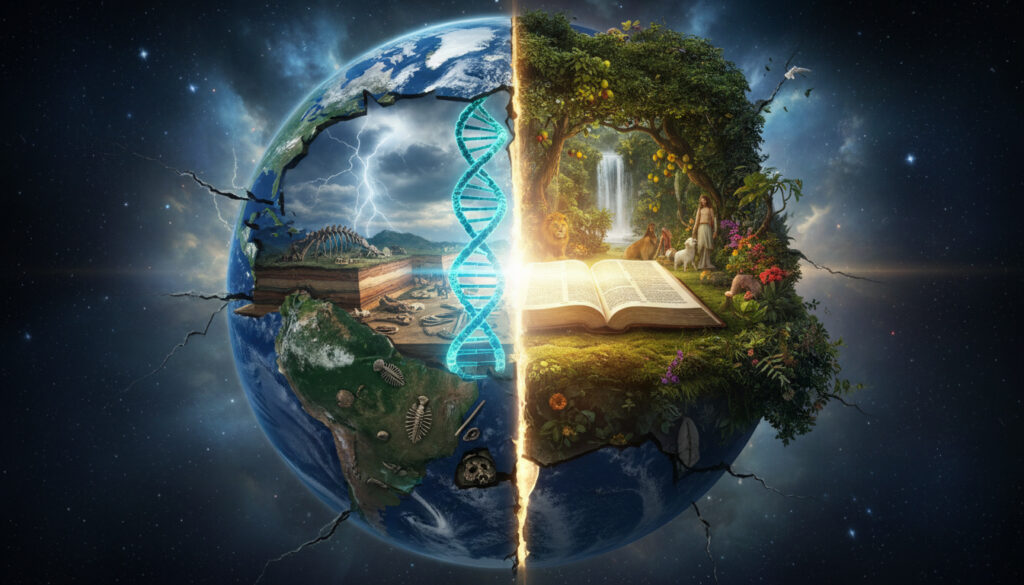
Who Was the First Person on Earth – Bible vs Science Facts
The question of who was the first person on Earth has captivated theologians, scientists, and philosophers for millennia. Genesis traces humanity’s origin to Adam and Eve in a garden, while evolutionary biology points to Mitochondrial Eve and Y-chromosomal Adam in ancient East Africa.
These narratives diverge dramatically on timeline, evidence, and what it means to be “first.” One rests on sacred scripture and theological interpretation; the other on mitochondrial DNA, fossil records, and molecular clocks calibrated against ancient remains.
Understanding both perspectives requires examining the claims each makes, the evidence supporting them, and why the gap between 6,000 years and 300,000 years matters for how we view human history.
Who Was the First Person on Earth According to the Bible?
| Viewpoint | Key Figure | Timeframe | Evidence |
|---|---|---|---|
| Biblical | Adam | ~4000 BCE | Scripture |
| Scientific Matrilineal | Mitochondrial Eve | ~150-200kya | mtDNA |
| Scientific Patrilineal | Y-Adam | ~200-300kya | Y-DNA |
| Mythological | Various | Ancient | Oral traditions |
- Biblical Adam appears in Genesis 2:7 as the first human created from dust, with God breathing life into him.
- Eve follows as the first woman, formed from Adam’s rib according to Genesis 2:21-22.
- Young Earth Creationists date this to approximately 6,000 years ago based on biblical genealogies and Ussher’s chronology.
- Old Earth Creationists place Adam around 150,000 years ago, reconciling with fossil evidence while maintaining supernatural creation.
- The Genesis account describes instantaneous creation rather than evolutionary development from pre-existing hominins.
- Traditional readings view Adam and Eve as literal sole progenitors of all humanity, without evolutionary precursors.
- Alternative interpretations suggest Adam as a representative figure or head of an existing population of early humans.
| Concept | Description | Estimated Date | Source Type |
|---|---|---|---|
| Adam (Biblical) | First man created from dust | ~4004 BCE (Young Earth) or ~150kya (Old Earth) | Scriptural |
| Eve (Biblical) | First woman created from Adam’s rib | Contemporary with Adam | Scriptural |
| Garden of Eden | Location of first humans | N/A | Genesis narrative |
| Creation Event | Supernatural origin of humanity | ~6,000 years ago (literal reading) | Biblical genealogy |
| Fall of Man | Original sin entering through Adam | N/A | Theological doctrine |
| Global Flood | Population bottleneck narrative | ~2348 BCE (Ussher chronology) | Genesis 6-9 |
Who Is the First Human According to Science?
What Is Mitochondrial Eve?
The woman whose mitochondrial DNA represents the most recent common ancestor (MRCA) of all living humans through maternal lines. Mitochondrial DNA passes exclusively from mother to offspring without recombination. Research estimates she lived approximately 150,000 to 250,000 years ago in East Africa, with molecular clock analyses aligning this timeframe with the earliest Homo sapiens fossils.
What Is Y-chromosomal Adam?
The male counterpart representing the MRCA for all living men’s Y-chromosomes, passed only from father to son. Recent studies suggest he lived roughly 200,000 to 338,000 years ago, with the discovery of haplogroup A00 pushing potential dates toward the older end. Mutation rate refinements have adjusted earlier calculations that suggested more recent dates.
The East African Evidence
Both genetic origins trace to small populations in East Africa. Stanford research confirms these common ancestors lived during roughly the same broad period, though not necessarily as contemporaries or the sole humans alive. Fossils from Jebel Irhoud, Morocco, dated to roughly 300,000 years ago, provide the earliest anatomically modern human remains, while Smithsonian archives document the gradual emergence of modern features.
Mitochondrial Eve and Y-chromosomal Adam were not the only humans alive, nor necessarily a couple or contemporaries. Their lineages survived while others died out over generations. The total human population during this era likely numbered between 1,000 and 10,000 individuals, ruling out descent from a single founding pair.
Bible vs Science: Comparing Views on the First Humans
Is Adam the First Human?
Young Earth Creationists affirm Adam as the literal first human created approximately 6,000 years ago through supernatural action, viewing him as the sole progenitor of all humanity. This position holds that Genesis describes historical reality rather than metaphor, with references to Adam and Eve as the first biblical figures indicating a literal beginning.
Reconciling Ancient Dates with Scripture
Old Earth perspectives suggest Adam and Eve lived around 150,000 years ago in East Africa, near regions proposed as Eden’s location. This view accepts the scientific timeline while maintaining Adam and Eve as a literal couple created supernaturally, arguing that Genesis genealogies serve theological rather than chronological purposes and rejecting the 6,000-year calculation.
Symbolic and Representative Views
Theistic interpretations suggest Adam may have existed within the last 20,000 years as a representative head of a larger population, or as a symbolic figure embodying the human relationship with the divine. This perspective holds that genetic MRCAs are merely DNA-specific ancestors, not biblical figures or species founders, with names chosen for cultural resonance rather than scientific correlation.
Despite the biblical names, Mitochondrial Eve and Y-chromosomal Adam are secular scientific concepts. Mainstream science makes no claim connecting these genetic ancestors to the biblical couple, and the evidence suggests they lived thousands of years apart and were surrounded by many other humans.
No genetic evidence supports a literal Adam and Eve living 6,000 years ago as the sole progenitors of humanity. The genetic diversity observed in modern humans requires a founding population significantly larger than two individuals, creating an irreconcilable conflict with strict young-earth chronology.
When Did the First Humans Appear?
- Early Homo genus emerges: Ancestral species appear 2.5–2.8 million years ago, sharing common ancestry with Neanderthals around 588,000–275,000 years ago. Source: Smithsonian Magazine
- Anatomically modern humans: Fossils from Jebel Irhoud, Morocco, dated to approximately 300,000 years ago, represent the earliest known Homo sapiens remains. Source: Smithsonian Human Origins
- Mitochondrial Eve lives: Estimated between 150,000–250,000 years ago in East Africa, representing the maternal MRCA for all living humans. Source: Molecular clock studies
- Y-chromosomal Adam lives: Estimated between 200,000–338,000 years ago, representing the paternal MRCA for all living males. Source: Population genetics research
- Behavioral modernity: Evidence of symbolic thought, art, and complex tools appears 70,000–100,000 years ago. Source: Archaeological record
- Out of Africa migration: Small groups of modern humans leave East Africa approximately 60,000–70,000 years ago, founding populations worldwide. Source: Genetic drift studies
- Biblical chronology: Based on Ussher’s calculations, creation occurs around 4004 BCE. Source: Biblical genealogy
What Do We Know for Certain About Human Origins?
| Established Information | Information That Remains Unclear |
|---|---|
| All living humans share common maternal ancestry traceable to a woman living roughly 150,000–250,000 years ago in East Africa. | Whether this genetic ancestor corresponds to any specific religious figure or historical individual named in ancient texts. |
| All living males share common paternal ancestry traceable to a man living roughly 200,000–338,000 years ago. | The exact population size of the human founding group at any specific moment and whether it ever dropped to two individuals. |
| Homo sapiens fossils date back at least 300,000 years, with anatomically modern features appearing gradually through evolutionary processes. | The precise mechanism of the transition from archaic to anatomically modern humans and the complete role of introgression from other hominin species. |
| The Genesis account describes Adam and Eve as the first humans created by divine action, dated to approximately 6,000 years ago by literal interpretations. | Whether the biblical narrative represents literal history, theological allegory, or a historical kernel with literary framing. |
| Genetic diversity in modern humans requires a founding population larger than two individuals, likely 1,000–10,000 breeding individuals. | The specific archaeological site or moment marking the emergence of behavioral, spiritual, or cognitive modernity. |
Why Do These Origins Stories Matter Today?
These competing narratives shape more than academic debate. The Who Was the First Person on Earth – Bible vs Science Facts framework influences bioethical positions, environmental stewardship views, and understandings of human equality and dignity.
For communities accepting biblical authority, Adam represents the imago Dei—the bearing of God’s image—establishing inherent human worth regardless of utility or ability. Scientific narratives emphasize biological continuity with other species while highlighting the unique cognitive and cultural capacities that emerged within the last 100,000 years.
Understanding both perspectives requires recognizing what each claims to explain. Science describes mechanism and biological ancestry through What Is Global Warming – Causes, Effects and Facts methodologies applied to deep time questions; theology addresses purpose and ultimate origins. The tension between 6,000 years and 300,000 years reflects different epistemological frameworks rather than merely conflicting data points.
What Do Primary Sources Say About the First Humans?
“Then the Lord God formed a man from the dust of the ground and breathed into his nostrils the breath of life, and the man became a living being.”
Genesis 2:7
“So the Lord God caused the man to fall into a deep sleep; and while he was sleeping, he took one of the man’s ribs and then closed up the place with flesh. Then the Lord God made a woman from the rib he had taken out of the man.”
Genesis 2:21-22
“Our findings suggest that, contrary to previous findings, male and female MRCAs lived around the same time, between 150,000 to 200,000 years ago.”
Stanford University School of Medicine, Genetic Research
What Is the Bottom Line on Humanity’s First Person?
The identity of the first person depends entirely on the framework employed. Biblical literalism points to Adam, created instantaneously approximately 6,000 years ago as the sole progenitor of humanity. Scientific consensus identifies Mitochondrial Eve and Y-chromosomal Adam as genetic common ancestors living 150,000 to 350,000 years ago within a larger population, not as the literal first humans. Those seeking deeper comparison of these origin narratives may consult Who Was the First Person on Earth – Bible vs Science Facts for extended analysis on how these perspectives continue to inform our understanding of human nature and history.
Who was the first woman on Earth?
The Bible identifies Eve as the first woman, created from Adam’s rib in Genesis 2. Scientifically, the concept of a “first woman” is less precise, though Mitochondrial Eve represents the most recent common maternal ancestor of all living humans, living roughly 150,000–250,000 years ago.
Did Mitochondrial Eve and Y-chromosomal Adam live at the same time?
Current genetic evidence suggests they lived during roughly the same broad timeframe, between 150,000 and 350,000 years ago, though likely thousands of years apart and not as a couple. They were not the only humans alive during their respective eras.
How many people were alive during the genetic bottleneck?
Genetic studies indicate the human population never dropped below approximately 1,000 to 10,000 breeding individuals. This rules out the possibility that humanity descended from a single original pair.
Is there DNA evidence for a literal Adam and Eve 6,000 years ago?
No genetic evidence supports a literal Adam and Eve living 6,000 years ago as the sole ancestors of humanity. Such a recent bottleneck would leave detectable traces in modern DNA diversity, which are absent.
What is the difference between a genetic ancestor and a genealogical ancestor?
A genetic ancestor contributes DNA to descendants, while a genealogical ancestor appears in one’s family tree. All humans share genetic ancestors (MRCAs), but we have millions of genealogical ancestors stretching back millennia.
Where exactly in East Africa did the first humans originate?
The East African Rift Valley, particularly regions of modern-day Ethiopia, Kenya, and Tanzania, provide the oldest Homo sapiens fossils and the highest genetic diversity, pointing to this area as the likely origin of modern humans.
Can science and the biblical account of Adam both be true?
Views vary. Some accept both by interpreting Adam as a historical figure living 150,000 years ago or as a representative head of a population. Others view them as incompatible explanations serving different purposes—empirical versus theological.
More related posts
 Queen Bed Width: US, UK & Ireland Compared
 How to Draw Anime: Beginner’s Step-by-Step Guide
 Mobile Service Providers NZ: Compare 2degrees, Spark, One NZ
 Tauranga Taupo River Level: Live Data, Maps & Safety Tips
 Potato Salad Recipe NZ: Secrets & Top Tips
 ANZ New Zealand SWIFT Code: ANZBNZ22 for International Transfers
 Mac and Cheese Recipe NZ: Tips, Best Cheeses & Easy Methods
 Westpac One Online Banking in NZ: Login and App Guide