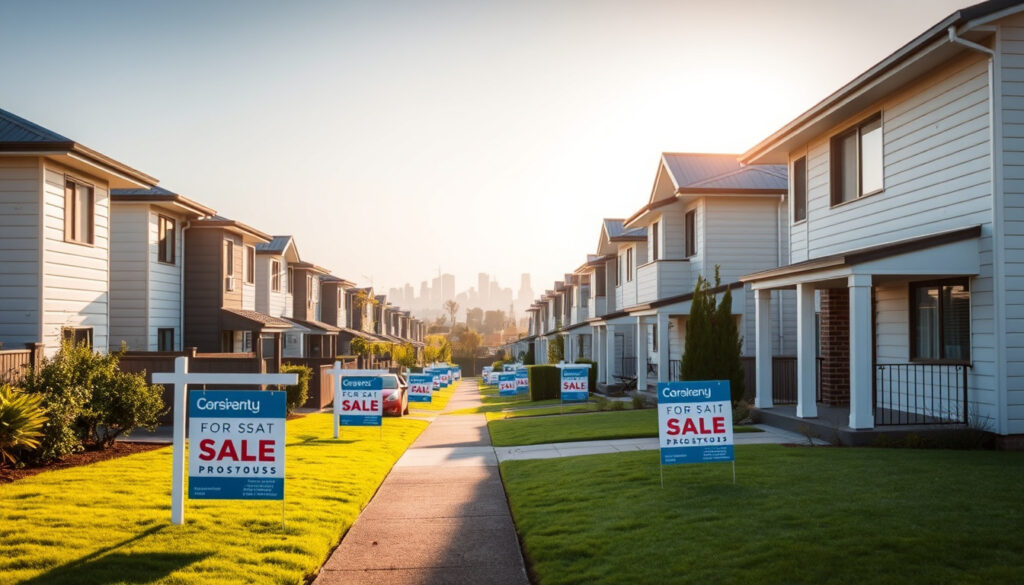
Houses for Sale in Auckland – Budget Under $500k to $800k
Anyone who has searched “house for sale Auckland” with a budget under $500,000 already knows how quickly the options shrink — the city’s median price sat at NZ$1,050,000 in 2024, pushing first-time buyers toward a thin slice of cheaper listings. The realistic path — apartments, units, cross-lease homes, and outer-suburb properties — is narrower than it once was, but it still exists if you know where to look.
Median house price in Auckland: NZ$1,050,000 (REINZ, 2024) ·
Listings on Realestate.co.nz: 15,896 ·
Listings under $500,000: ~5–10% (est.) ·
Average days on market: 32 days (Barfoot & Thompson, 2024)
Quick snapshot
- The First Home Grant closed in May 2024 (New Zealand Government).
- Auckland’s median house price is NZ$1,050,000, and listings under $500,000 are roughly 6% of the market (REINZ and Realestate.co.nz estimates). (New Zealand Government)
- The exact number of 3-bedroom houses under $500,000 changes weekly as listings appear and go under offer (Realestate.co.nz listing data).
- Future price direction depends on interest rates and housing supply across the region (Barfoot & Thompson market analysis).
- Under the old HomeStart scheme, eligible buyers could receive up to NZ$20,000 toward a new build — more generous than anything on offer now (Beehive (NZ Government)).
- Get pre-approved and set a max-price filter — first-home buyers can enter the market with a 5% deposit through the First Home Loan (Hobsonville Point).
One pattern runs through these numbers: support that used to shrink the deposit has gone, while the price floor keeps rising.
| Metric | Value |
|---|---|
| Auckland median house price | NZ$1,050,000 (REINZ, 2024) |
| Share of listings under $500,000 | ~6% (estimate from Realestate.co.nz data) |
| Most affordable suburb by median | Pukekohe — est. NZ$650,000 |
| Typical deposit expected by lenders | 20% of purchase price |
| First Home Grant status | Closed to new applications in May 2024 (New Zealand Government) |
| KiwiSaver first-home withdrawal | Still available for eligible buyers (Consumer NZ) |
| First Home Loan minimum deposit | 5% (Hobsonville Point) |
| Average days on market | 32 days (Barfoot & Thompson, 2024) |
| First Home Loan price cap (newer rules) | NZ$875,000 (Mortgages.co.nz) |
None of those numbers move in a buyer’s favor quickly, which is why the search strategy has to be engineered around price tiers.
What houses for sale in Auckland are under $500,000?
The short answer: very few, and almost none of them are standalone houses. Around 6% of current Auckland listings sit below the $500,000 mark, and buyers in this band are choosing a property type as much as a price.
Overview of the under-$500k market
- Under-$500,000 listings are roughly 6% of the Auckland market on Realestate.co.nz — a thin slice against a citywide median of NZ$1,050,000 (REINZ, 2024).
- Most of these properties are apartments, units, or cross-lease homes rather than detached houses.
- Auckland’s old HomeStart house price cap was NZ$550,000 — a benchmark that shows how far the low end has moved since (Beehive (NZ Government)).
The under-$500,000 market is not a normal slice of Auckland real estate; it is a niche of compromises. Buyers who insist on a full standalone house will find very little, while buyers who accept an apartment or a unit title will find genuine options.
Typical property types at this price point
- Studio and one-bedroom apartments in central suburbs such as the CBD, Mount Albert, and Newmarket.
- Older two-bedroom units on cross-lease titles in suburbs like Avondale and Mount Roskill.
- Leasehold units, where the land underneath is rented — the sticker price is lower because the land is not included.
- Smaller houses in semi-rural zones such as Pukekohe and the outskirts of greater Auckland.
A leasehold listing can look like a bargain until the ground rent is factored in. The purchase price is low because the land under the building is not part of the deal, and the ground rent obligation continues indefinitely.
Budget buyers face an extra layer of due diligence because the cheapest Auckland listings are typically cross-lease, unit title, or leasehold — each with ongoing costs and shared responsibilities that a freehold title avoids.
Suburbs where under-$500k houses exist
- Pukekohe: one of the most affordable suburb medians in Auckland (est. NZ$650,000), with older homes and units occasionally listing below $500,000 on the town fringe.
- Papakura and Manurewa: older units and townhouses below the cap, though detached houses mostly sit higher.
- Outer semi-rural townships: small freehold houses appear under $500,000 more often than anywhere inside the isthmus.
These are not central suburbs. A $500,000 budget means building a real commute into the math — but for buyers who can adjust schedules or work remotely, the trade can be worth it.
What houses for sale in Auckland are available between $500,000 and $800,000?
This is the bracket where Auckland’s budget segment actually functions. It holds roughly a quarter of current listings, and it is where most first-time buyers land.
Mid-range price bracket overview
- Around 25% of Auckland listings fall between $500,000 and $800,000, the largest affordable band in the market.
- REINZ data shows median prices under $800,000 are common across the southern suburbs, including Papakura, Manukau, and parts of Henderson.
- Typical properties: 2–3 bedroom units, townhouses, and older cross-lease homes — more space than the sub-$500k band, with a more workable deposit.
At $800,000, a 20% deposit is NZ$160,000 — still steep, but achievable with KiwiSaver plus savings. At $500,000, the same deposit drops to NZ$100,000, which is why this band matters for first-home buyers.
Typical houses: 2–3 bedroom units and townhouses
- Two-bedroom units in Papakura and Manurewa, often cross-lease, typically in the $550,000–$650,000 range.
- Three-bedroom townhouses in Manukau and East Auckland between $650,000 and $780,000.
- Older three-bedroom homes in Henderson and Massey with freehold or cross-lease titles around $700,000–$800,000.
The step up from $500,000 buys meaningful things: an extra bedroom, a private yard, and sometimes a freehold title. For many Auckland buyers, this is the realistic entry point to a house rather than a unit.
Popular suburbs: Papakura, Manukau, Henderson
- Papakura: direct rail to the CBD and a high concentration of sub-$800k houses in the south.
- Manukau: townhouse stock close to the city centre and motorway access.
- Henderson: a mix of older homes and new townhouses, with the local centre going through renewal.
First-home buyers in this band have the clearest path into the market because the First Home Loan’s 5% deposit option lowers the cash hurdle to NZ$25,000–$40,000 — not easy, but far closer for a KiwiSaver saver.
Where can I find 3-bedroom houses for sale in Auckland under $500,000?
A three-bedroom standalone house under $500,000 is the hardest single ask in Auckland’s market. It exists, but it is rare, and it usually comes with a long commute.
Challenges finding 3BR under $500k
- Most sub-$500k listings are one- or two-bedroom apartments and units; three-bedroom standalone houses are a minority within a minority.
- The exact count shifts weekly as listings go under offer, which is why any static number is quickly outdated.
- Where three-bedroom houses do appear under $500k, they tend to sit in rural or semi-rural zones rather than inside the urban footprint.
Examples of outer suburbs with 3-bedroom houses under $500k
- Pukekohe: the most cited source of 3-bedroom houses near the $500,000 mark, with a suburb median far below the city’s NZ$1,050,000.
- Semi-rural zones around the Auckland boundary: occasional listings under $500,000, usually with larger land and longer drives.
- Cross-lease homes: three-bedroom houses on shared titles can undercut the cap in suburbs like Papakura and Henderson.
Alternative housing types: cross-lease or shared ownership
- Cross-lease houses share the underlying land with neighbours, which lowers the entry price.
- Unit-title townhouses can deliver three bedrooms in the $550,000–$600,000 range — above the strict cap but far below the median.
- Shared-ownership and progressive ownership programs in Auckland remain limited and generally waitlisted.
The practical answer: if three bedrooms is the hard requirement, most budget buyers get there through a cross-lease title rather than a detached freehold.
What are the best resources for cheap houses for sale in Auckland?
Finding the cheap listings is less about insider knowledge and more about using the portals correctly. The big three property sites in New Zealand all work, but they reward buyers who set tight filters.
Top real estate portals: Trade Me, Realestate.co.nz, OneRoof
- Trade Me Property lists more than 16,000 Auckland homes and offers saved searches with instant alerts.
- Realestate.co.nz is the industry-wide listing site, with filters for price, bedrooms, and property type.
- OneRoof adds suburb-level market data and sold prices, which helps you judge whether a low-priced listing is genuinely undervalued.
Using filters to set max price
- Set the max-price filter to $500,000 or $550,000 rather than browsing broadly — it changes the results page completely.
- Add a “3+” bedroom filter and sort by newest first to surface fresh stock.
- Use map view to include the outer suburbs where the sub-$500k pockets live.
Setting alerts for new listings
- Trade Me’s saved search emails fire within minutes of a new listing matching your criteria.
- Realestate.co.nz lets you set daily alerts for a price range and receive a digest of new listings.
- Act fast: the cheapest Auckland listings typically draw multiple enquiries within hours, not days.
The buyer who wins a sub-$500k Auckland listing is usually the one who saw it first — a well-configured alert beats open-home timing and negotiation skill combined.
How do I buy a house in Auckland with a limited budget?
The buying sequence for a budget Auckland home is the same as for any house, with one difference: you cannot afford to skip a step, because the inventory is thin and the competition is real.
- Step 1: Get pre-approved
- Check your KiwiSaver balance — eligible first-home buyers can withdraw most of their contributions, plus member tax credits, toward a deposit.
- Ask your bank about the First Home Loan, which lets eligible first-time buyers purchase with a 5% deposit (Hobsonville Point).
- Compare home loan rates before choosing a lender (Home Loan Rates Comparison NZ).
- Step 2: Search within budget
- Use the $500,000–$800,000 bracket as the base, then drill down with max-price filters.
- Cover the southern and western suburbs — Papakura, Manukau, Henderson — where the affordable stock concentrates.
- Track a shortlist weekly and watch what sells, and at what price.
- Step 3: Attend open homes
- View enough homes in your bracket before offering to calibrate condition and value.
- Look beyond styling: check the title, the cladding, and the age of the roof.
- Ask about body-corporate fees for unit-title properties — they change the monthly math significantly.
- Step 4: Make an offer
- Get a building inspection and a LIM report before signing anything.
- Use a conveyancing lawyer to review the sale and purchase agreement.
- Be prepared to move fast — budget listings in Auckland routinely sell within days.
- Step 5: Conveyancing and settlement
- Your lawyer completes the title transfer and checks for outstanding rates or consent issues.
- Arrange home insurance from the contract date — lenders require it before settlement (Best Home Insurance NZ).
- Budget for legal fees, rates adjustments, and moving costs on top of the deposit.
The same sequence works at every price point, but the discipline matters more at the low end. A buyer who skips the LIM check or the pre-approval can lose both the house and the deposit.
A budget listing in Auckland can hide expensive surprises — leaky cladding, unconsented extensions, or body-corporate arrears. The cheapest house on the street can become the most expensive repair project in the suburb.
Pros and Cons of Buying a House in Auckland on a Budget
Every Auckland budget purchase is a set of trade-offs. Here they are, side by side.
Upsides
- KiwiSaver withdrawals and the First Home Loan’s 5% deposit option keep a low-deposit path open for eligible buyers.
- The $500,000–$800,000 band holds roughly a quarter of Auckland listings — enough variety to compare before committing.
- Affordable suburbs like Pukekohe and Papakura have rail or motorway links, making the commute cost predictable.
Downsides
- The First Home Grant closed in May 2024, so the direct cash top-up is gone.
- Listings under $500,000 are about 6% of the market, which means thin options and fast sales.
- Low-deposit lending often carries higher interest rates or lender mortgage insurance, adding to monthly repayments.
What’s Confirmed, What’s Still Unclear
Before making an offer, separate what is known from what is guesswork.
Confirmed facts
- The old HomeStart rules required at least three years of KiwiSaver contributions before applying (Consumer NZ).
- The later First Home Grant used higher income caps: NZ$95,000 for singles and NZ$150,000 for two or more buyers (Crockers).
- A worked government example from the HomeStart era: a couple earning NZ$50,000 each could withdraw NZ$35,000 from KiwiSaver, add a NZ$20,000 grant, and assemble a NZ$55,000 deposit for a new home (Beehive (NZ Government)).
What’s still unclear
- The exact number of 3-bedroom houses under $500,000 at any moment — it moves every week and no portal publishes a stable count (Realestate.co.nz search data).
- Where prices head next: interest-rate decisions and new housing supply could widen or shrink the affordable band (Barfoot & Thompson market report).
- Whether the NZ$875,000 first-home price ceiling from the newer rules persists or adjusts with the market (Mortgages.co.nz).
What the Guidance Says
The first-home support system in New Zealand has shifted: the old grant closed, and the main pathway now runs through KiwiSaver withdrawals and the First Home Loan, with a 5% deposit option for eligible buyers.
New Zealand Government (housing guidance)
Under the grant rules that applied until recently, buyers had to meet income caps, contribute to KiwiSaver for three years or more, and commit to living in the home for at least six months.
Crockers (Auckland property managers)
What This Means for Your Auckland House Hunt
The budget end of Auckland’s market is not a myth, but it is a discipline. Buyers who target the $500,000–$800,000 band, filter ruthlessly, and use KiwiSaver and the First Home Loan to shrink the deposit hurdle have a realistic path; buyers who wait for a $500,000 standalone house in a central suburb will keep waiting.
consumer.org.nz, finchmortgages.co.nz, vive.co.nz, wiseup.nz, mortgages.co.nz, fletcherbuilding.com, kaingaora.govt.nz
Frequently asked questions
What is the cheapest house currently for sale in Auckland?
The cheapest active listings in Auckland are almost always apartments or leasehold units, while the smallest freehold houses in outer suburbs occasionally list just under $500,000. The exact figure changes every few days, so a max-price alert on the major portals is the only reliable way to track it.
What are the first-time buyer grants available in New Zealand?
The First Home Grant closed in May 2024. Current support runs through KiwiSaver withdrawals and the First Home Loan, which lets eligible buyers purchase with a 5% deposit. Under the older HomeStart scheme, the grant reached up to NZ$20,000 for a new build.
How much deposit do I need to buy a house in Auckland?
Most lenders expect 20%, which is NZ$210,000 on the median-priced Auckland house. Through the First Home Loan, eligible buyers can enter with a 5% deposit, and KiwiSaver withdrawals can contribute part of that amount.
Are there any houses for sale in Auckland under $400,000?
Rarely, and they are almost always apartments, leasehold units, or properties with title complications. A three-bedroom standalone house under $400,000 is extremely rare in the Auckland region; a freestanding home realistically starts closer to $500,000.
What is the best real estate website to find cheap houses in Auckland?
Trade Me Property has the largest listing volume and the fastest alerts. Realestate.co.nz is the industry-wide site with reliable price filters, and OneRoof adds suburb-level sold data. Use all three with a max-price filter for the best coverage.
How long does it typically take to sell a house in Auckland?
Auckland homes averaged 32 days on the market in 2024, according to Barfoot & Thompson. Cheaper listings tend to sell faster, so budget buyers should expect to act within days of a new listing appearing.
Do house prices in Auckland vary by suburb significantly?
Yes. The gap between Auckland suburbs is wide: Pukekohe’s median is estimated around NZ$650,000, while the citywide median is NZ$1,050,000. That spread is why budget buyers usually find their target in the south or west rather than the central isthmus.
More related posts
 Arsenal vs Wigan Athletic Lineups: Confirmed XI & Result
 Te Paepae o Aotea: Login, Reviews & Uniform Guide
 Fisher & Paykel Top Loader: Problems, Lifespan & Review
 Synopsis of November 9 – Full Plot Summary and Themes
 Taupo to New Plymouth: Driving, Flights, Bus & Best Stops
 Dana White Net Worth 2025: Forbes Estimates Over $600M
 Fish Cakes Recipe NZ: Traditional, Easy & Crispy Guide
 Bay of Islands Accommodation: Best Paihia & Kerikeri Stays