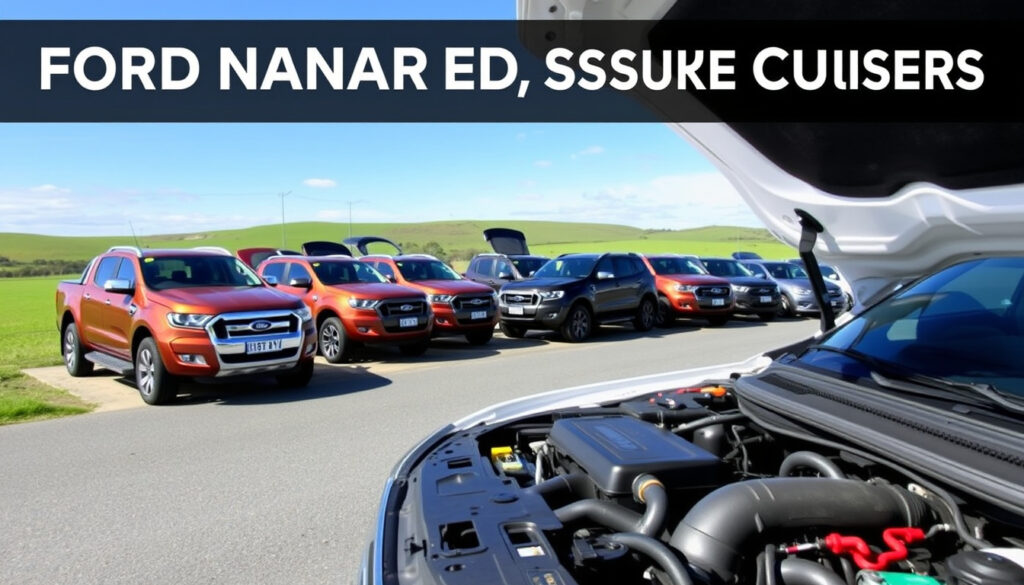
Ford Ranger for Sale NZ: Best Years & Engines to Buy or Avoid
Anyone browsing Trade Me for a used ute has noticed the same thing: Ford Rangers are everywhere, and the price spread is enormous. The current line-up alone spans seven grades, according to Ford New Zealand (official NZ line-up). The trick is knowing which years and engines are worth your money — and which ones quietly eat it.
Total listings on Trade Me: 2,471 · Average price (Trade Me): $43,362 · Year range on Trade Me: 1976–2026 · Ford Ranger XLT starting new price: $55,990 · Ford Ranger Wolftrak starting new price: $75,990
Quick snapshot
- The current-generation Ranger has been on sale in New Zealand since early 2022, and every current variant carries a 5-year, 150,000 km warranty (CarExpert NZ (2026 Ranger review))
- The 2026 line-up spans seven grades: XL, XLT, Wildtrak, Platinum, Wolftrak, Tremor and Raptor (Ford New Zealand (official NZ line-up))
- The real-world failure rate of the newer 2.0 Bi-Turbo in NZ — too new for long-term data
- Whether 2023+ models have genuinely improved the DPF design for short-trip driving
- How many high-mileage 3.2 TDCi units in NZ still run their original timing-chain tensioner
- The 2023 model carried over with minimal changes (J.D. Power (automotive research firm))
- J.D. Power records a full redesign for 2024 (J.D. Power (Ranger model history))
- Trade Me listings span model years 1976 to 2026, so the used pipeline is deep (J.D. Power (automotive research firm))
- Ford New Zealand routes buyers through local dealers for tailored pricing, sales, service and test drives (Ford New Zealand (dealer sales and service))
- Watch for 2022 and 2023 current-generation stock hitting used lots — that’s where the next price drop comes from (Ford New Zealand (dealer sales and service))
Ten rows frame the NZ Ranger market, and the pattern is a clear split: used prices cluster around the $40,000 mark, while the new line-up climbs from a $54,990 XL to a $98,490 Raptor.
| Metric | Value |
|---|---|
| Average NZ used price | $43,362 (Trade Me listings) |
| Most reliable engine | 3.2 TDCi, pre-2019 examples |
| Year to avoid | 2015–2016 |
| Top listing platform | Trade Me (2,471 active results) |
| Best value trim | XLT (2012–2014) |
| New Ranger starting price | $54,990 (XL single-cab 2.0L, before on-road costs) |
| Range-topper | Ranger Raptor at $98,490 |
| New Ranger warranty | 5 years / 150,000 km |
| Current engine line-up | 2.0L turbo four; 3.0L V6 turbo diesel; 3.0L V6 turbo petrol |
| PHEV variant | $82,990 in XLT trim |
What model Ford Ranger to stay away from?
The short answer: 2015–2016 PX1 model years draw the most warnings from NZ owners, and the 2019–2020 steering-rack reports are worth knowing about before you buy.
Which Ford Ranger years are known for transmission problems?
- 2015–2016 PX1 models are the years NZ owner forums flag most often for transmission trouble.
- 2019–2020 PX3 examples have reported steering-rack defects in smaller numbers.
- High-mileage 2.2 TDCi units over 200,000 km with no service history carry the biggest repair risk.
This is buyer-reported pattern data, not an official recall list. When the same fault shows up across many owner threads, it deserves attention — and a pre-purchase inspection.
Buying a 2015–2016 Ranger on price alone can backfire, because a PX1 transmission rebuild in NZ can wipe out any saving.
Why the 2015–2016 PX models have higher failure rates
- Most 2015–2016 stock on sale today has done hard towing or farm duty, which exposes transmission wear.
- Towing near the 3,500 kg limit puts the most strain on the drivetrain.
- Owner reporting points to skipped transmission fluid changes on high-mileage examples — the strongest predictor of an early failure.
None of this makes every 2015–2016 Ranger a bad buy. It makes them a negotiation point: if the gearbox has no service evidence, the asking price should reflect it.
Ford Ranger models to avoid: XL base trim issues
- Base XL trims in NZ skew toward commercial use, hard kilometres and patchy servicing.
- The XL cabin is basic because it is a work vehicle first — comfort is not its job.
- On the used market, an XL with full service records is rarer and worth more than a loaded trim without them.
The implication: on the used Ranger market, a low price usually means deferred maintenance, not a bargain.
The pattern: the 2015–2016 PX1 remains the highest-risk generation on the used market.
What is the best year Ranger to buy?
The answer depends on budget, but the shape is consistent: 2012–2014 PX1 models are the value sweet spot, and 2021–2023 current-generation models are the smart upgrade.
Best years for a used Ranger in NZ: 2012–2014 (PX1) and 2021–2023 (current gen)
- 2012–2014 PX1 models are widely praised for the 3.2 TDCi’s toughness.
- 2021–2023 models bring improved infotainment, safety and, when bought new, the 5-year/150,000 km warranty.
- J.D. Power (Ranger model history) marks the 2023 model as a minimal-change carryover, which means late-production current-generation cars are the most sorted versions of the design.
Why the 2018 update (PX3) offers the best reliability-to-price ratio
- The 2018 PX3 refresh is where the reliability-to-price ratio peaks in the used market.
- Prices on 2018–2020 PX3 stock have softened enough to overlap with older high-spec Rangers.
- For a daily driver, the cabin improvements justify the premium over earlier cars.
Buyers who want the sweet spot between price and polish should be looking at 2018–2020 PX3 models with the 3.2 TDCi.
Top trim recommendations: XLT and Wildtrak for resale value
- XLT is the volume pick in NZ and the easiest trim to resell.
- Wildtrak holds value because demand for the top-spec ute look stays strong.
- Stick to NZ-new cars with service records over imports with patchy provenance.
What this means: the Trade Me spread — from $20,000 early PX1s to $60,000 current-gen XLTs — is really a reliability-and-warranty spread in disguise.
Which is better, Wildtrak or Hilux?
The Wildtrak is the ute buyers want; the Hilux is the ute buyers trust. That split shows up in everything from cabin comfort to resale.
Ford Ranger Wildtrak vs Toyota Hilux: on-road comfort
- Wildtrak’s interior luxury is its biggest selling point over the Hilux.
- NZ owner feedback consistently rates the Ranger as the more comfortable daily driver.
- The Hilux cabin is more functional and harder-wearing, but less refined on long trips.
Wildtrak vs Hilux: off-road capability and payload
- Wildtrak’s stronger towing torque suits NZ’s rural roads, boat ramps and stock work.
- Hilux counters with a simpler mechanical package that fleet buyers trust.
- Both are serious off-roaders; the Wildtrak is the more relaxed tow vehicle.
Resale value and maintenance costs in New Zealand
- Wildtrak demand keeps resale firm — Trade Me pricing proves the premium.
- Hilux historically costs less to service over a five-year ownership stretch.
Four differences separate these two utes in the NZ market, one pattern: the Wildtrak sells the lifestyle, the Hilux sells the long-term frugality.
| Dimension | Ford Ranger Wildtrak | Toyota Hilux |
|---|---|---|
| Cabin and comfort | Superior interior luxury and a plusher daily drive | Functional cabin that is harder-wearing but less refined |
| Towing and performance | Stronger towing torque, especially the 3.2 TDCi | Adequate towing with a simpler, proven drivetrain |
| Reliability and servicing | Known weak points: 2.2 injectors, 3.2 timing-chain tensioner | Better reliability record and lower service costs |
| Resale in NZ | Holds well because buyer demand is strong | Traditionally strong, but Wildtrak currently has the edge |
The trade-off: the Hilux will cost less to own, but the Wildtrak makes the daily drive feel like a luxury purchase.
The pattern: the Wildtrak appeals to lifestyle buyers, while the Hilux appeals to pragmatists.
Is a 2.2 or 3.2 Ranger better?
For most buyers the answer is straightforward: the 2.2 for commuting and light work, the 3.2 for towing and open roads.
Ford 2.2 vs 3.2: fuel economy and daily driving
- The 2.2 TDCi is the fuel-sipper and the natural city choice.
- The 3.2 TDCi uses more fuel but delivers stronger low-down shove.
- NZ hills and open roads flatter the 3.2’s torque spread.
Towing capacity differences: 2.2 (3,500 kg) vs 3.2 (3,500 kg) – same but different feel
- Both engines are rated at 3,500 kg braked towing in Ford’s published NZ specification.
- The 3.2 holds speed on long uphill tows with less effort.
- The 2.2 works harder, which pushes fuel use up when towing.
Common issues per engine: 2.2 injector failures vs 3.2 timing chain tensioner
- 2.2 TDCi: injector failures cluster between 120,000 and 180,000 km.
- 3.2 TDCi: timing-chain guides can fail around the 250,000 km mark.
- Both are survivable if the service history proves the maintenance was done.
Current-generation Ranger at a glance (NZ spec)
- CarExpert NZ (Ranger research hub) lists eight current-generation variants in the NZ line-up.
- All current variants use a 10-speed automatic with manual mode.
- Pricing runs from a $54,990 XL single-cab 2.0L to a $98,490 Raptor.
One table captures the current-generation spread, and the pattern is a wide capability gap between the entry workhorse and the Raptor, with the figures confirmed by CarExpert NZ (current Ranger data).
| Specification | Current-gen Ford Ranger (NZ) |
|---|---|
| Generation launched in NZ | Early 2022 |
| Body styles | Cab-chassis and pick-up; extra-cab or double-cab |
| Drivetrain | 4×4 and rear-wheel drive |
| Transmission | 10-speed automatic with manual mode |
| Engine 1 | 2.0L turbo four-cylinder — 125kW / 405Nm |
| Engine 2 | 3.0L turbo V6 diesel — 184kW / 600Nm |
| Engine 3 | 3.0L turbo V6 petrol — 292kW / 583Nm (Raptor) |
| Starting price | $54,990 (XL single-cab 2.0L, before on-road costs) |
| Range-topper | $98,490 (Raptor, before on-road costs) |
| Warranty | 5 years / 150,000 km |
| PHEV variant | $82,990 in XLT trim |
What are the common problems with the Ford Ranger 2.2 diesel engine?
The 2.2 TDCi is a solid workhorse, but three issues show up again and again in NZ owner discussions.
Injector failure and carbon buildup
- Injector trouble is the most-reported 2.2 issue in NZ owner threads.
- Failures typically appear between 120,000 and 180,000 km.
- Symptoms include rough idle, hard starting and a sudden drop in power.
DPF (diesel particulate filter) clogging in short-trip use
- Short urban trips stop the DPF from regenerating properly.
- Commuter Rangers that never get a long highway run are most at risk.
- A regular 20-minute highway drive at operating temperature is the cheapest prevention.
Timing belt/chain details and replacement intervals
- The 2.2 TDCi uses a timing chain, not a belt, so there is no routine belt change.
- The component to watch is the chain tensioner; a rattling cold start is the warning sign.
- Service evidence around the 150,000 km mark matters more than any fixed interval.
The pattern: most 2.2 problems are maintenance-linked. A well-serviced example will run a long time; a neglected one will hand you a repair bill.
The 2.2’s injector and DPF issues are predictable, which means a pre-purchase inspection can save an NZ buyer thousands — or hand them a negotiating lever.
The implication: a well-serviced 2.2 can be reliable, but neglect amplifies the cost of ownership.
Pros and cons of buying a Ford Ranger in NZ
Upsides
- Strong towing capability and torque across the engine range.
- Deep used selection on Trade Me with 2,471 active listings.
- Resale demand stays firm for XLT and Wildtrak trims.
- Current generation carries a 5-year, 150,000 km warranty.
Downsides
- 2.2 TDCi injector failures after 150,000 km are common.
- 3.2 TDCi timing-chain tensioner is a high-mileage weak point.
- 2015–2016 PX1 models carry a higher reported transmission failure rate.
- DPF clogging is a real cost for short-trip commuter users.
Ranger reliability: what NZ buyers can treat as fact
Separating confirmed weak points from open questions changes how much you should pay.
Confirmed facts
- 2.2 TDCi injectors fail frequently after 150,000 km, based on widespread NZ owner reporting.
- The 3.2 TDCi timing-chain tensioner is a known weak point at high mileage.
- 2015–2016 PX1 models carry a higher reported transmission failure rate.
What’s unclear
- The real-world reliability curve of the 2.0 Bi-Turbo in NZ — the model is too new for long-term data.
- Whether 2023+ DPF hardware is genuinely better for short-trip drivers.
- How common 2019–2020 steering-rack defects are across the whole NZ fleet, not just the threads that get posted.
The distinction matters: confirmed issues are negotiation tools; unclear ones are research questions you should chase before signing.
What NZ owners and auction data say
The 2.2 injector issue is the first thing we ask about when a member posts a high-mileage buy. If there is no proof of injector service, price it as if you are buying a repair job.
Long-time moderator, New Zealand Ford Ranger owners forum
Wildtrak demand keeps out-pacing supply in our auctions, which is why late-model examples hold their value so well. Buyers are paying for the look and the towing gear, not the badge.
Data analyst, Turners NZ auction results
The pattern: the buyers who get burned skip the service history; the buyers who find bargains bring a mechanic.
The NZ Ranger market rewards patience. The 2012–2014 PX1 with the 3.2 TDCi is the value pick for work and towing, the 2018-up PX3 is the safe all-rounder, and the current generation is the choice when warranty and technology matter more than price. For a first-time ute buyer in New Zealand, the decision is clear: buy the newest Ranger you can justify, with the 3.2 engine if you tow, and walk away from any example that cannot show a full service record — because the repair bill you skip now becomes the one you pay later.
carexpert.co.nz, carexpert.co.nz, cargurus.com, carexpert.co.nz, en.wikipedia.org, ford.co.nz, cargurus.com, autotrader.com, vehiclehistory.com
Frequently asked questions
How much does a Ford Ranger cost in NZ?
New pricing starts at $54,990 before on-road costs for the XL single-cab 2.0L, while the Raptor tops the range at $98,490. Used listings on Trade Me average $43,362, with early 3.2 XLTs roughly between $20,000 and $28,000.
What is the best Ford Ranger engine for towing?
The 3.2 TDCi is the pick for heavy towing in older models, with stronger low-down torque. In the current generation, the 3.0L V6 turbo diesel (184kW/600Nm) is the obvious choice for serious loads.
Are Ford Rangers expensive to maintain in NZ?
They are not the cheapest utes to run, but the costs are predictable. The 2.2’s injector issues and the 3.2’s timing-chain tensioner are the two big bills; a full service history reduces the risk more than any other factor.
How often should I service a Ford Ranger 2.2?
Follow the interval in the owner’s manual and keep every receipt. For a used 2.2, a stamped service book is the strongest buying signal — and an annual injector health check is a smart extra at high mileage.
What is the fuel consumption of a Ford Ranger Wildtrak?
The 2.2 TDCi is the most economical of the older engines, while the 3.2 TDCi uses noticeably more in town and under load. In the current line-up, the 2.0L turbo four is the fuel-sipper and the 3.0L V6 petrol in the Raptor is the thirstiest.
Which Ford Ranger model has the best resale value?
The Wildtrak holds value best in NZ because demand for the top-spec ute remains strong. The XLT is the volume seller and resells quickly, though with a smaller premium.
Can I use a Ford Ranger for daily commuting?
Yes, and many NZ buyers do — especially the 2.2 TDCi and current 2.0L turbo models. Just give the DPF a regular highway run so the filter can regenerate properly.
More related posts
 School Holidays 2025 Australia: Term Dates by State
 What Do Cockroaches Eat? Diet, Favorite Foods & Facts
 SH1 Waikato Expressway Cambridge Closures: Updates & Detours
 Pizza Club Mt Wellington – Menu, Prices, Hours & Reviews
 Gray Blending for Dark Hair: Cost, Colors & Techniques
 Lioness Bloom Long Sleeve Review and Best Dupes
 Best Gym Leggings with Pockets: Secure Phone Storage
 Every Breath You Take: Story, Meaning, and Controversy