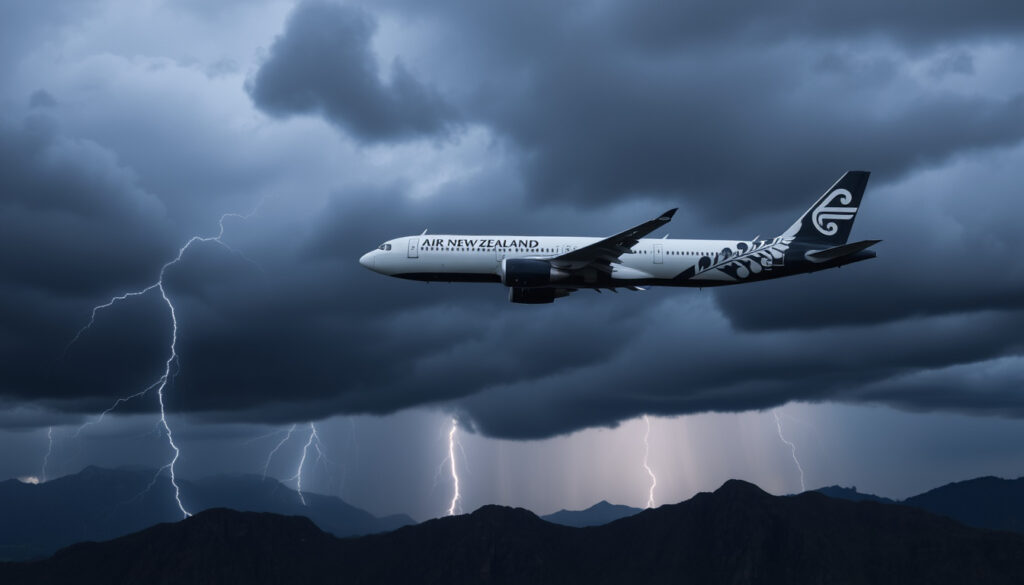
Turbulent Air New Zealand Flights to Dunedin: Key Incidents
Anyone who has gripped their armrest during a bumpy descent knows the feeling: the sudden drop, the collective gasp — a feeling that became extreme reality for passengers on an Air New Zealand flight from Wellington to Queenstown in June 2024, when turbulence left two people injured. This article breaks down what happened, what makes New Zealand flights prone to turbulence, and how the airline manages the risk — with the facts you need to stay informed.
Injuries reported from turbulence (2024–2025): 2 · Worst incident: Flight NZ671 on 30 May 2025 (extreme) · Recent turbulence incidents on Air NZ Dunedin flights: 3
Quick snapshot
- Flight NZ607 (16 June 2024): crew and passenger injured (Crux (local news outlet))
- Paramedics transferred both to Lakes District Hospital (AeroTime (aviation news))
- No fatalities in any reported incident (Boeing Aero magazine (aviation safety publication))
- Exact cause of turbulence on NZ607 (clear air vs. weather) — not confirmed by Air New Zealand
- Long-term trends in turbulence severity on NZ routes — no published longitudinal data
- Official Air New Zealand statement compilation — no centralized source exists
- June 2024: NZ607 incident (Crux (local news outlet))
- October 2024: NZ626 aborted landings (The New Zealand Herald (national news outlet))
- May 2025: NZ671 extreme turbulence (Otago Daily Times (regional newspaper))
- Air New Zealand reviews cabin service policies (AeroTime (aviation news))
- Passengers advised to keep seatbelts fastened (Crux (local news outlet))
The table below assembles the key identifiers for the Air New Zealand turbulence incidents that have drawn attention since 2024.
| Label | Value |
|---|---|
| Airport | Dunedin Airport (DUD) |
| Airline | Air New Zealand |
| Recent incident date | 30 May 2025 |
| Injuries reported (2024–2025) | 2 |
| Worst incident per passenger accounts | Flight NZ671 on 30 May 2025 |
What is the most turbulent flight route?
Global turbulence rankings from Turbli
Aviation analytics firm Turbli publishes an annual list of the most turbulent flight routes worldwide, based on eddy dissipation rate data. While no New Zealand route ranks in the global top 10, trans-Pacific flights to and from the country often experience moderate turbulence due to the jet stream. A comprehensive analysis from Boeing Aero magazine (aviation safety publication) notes that severe turbulence remains a recognized hazard even on domestic routes.
Turbulent routes to and from New Zealand
Dunedin Airport (DUD) is especially known for challenging wind conditions due to its location near the Otago Peninsula and prevailing westerlies. According to Crux (local news outlet), passengers on the NZ607 flight described turbulence as more powerful than anything they had experienced anywhere in the world — the region’s erratic air currents amplify normal flight risks.
Even on short domestic hops, the combination of mountain terrain and sea breezes can create sudden updrafts and downdrafts that catch aircraft during final approach.
The implication: New Zealand’s geography, not airline negligence, drives the bumpiness — and passengers should expect it.
What time of day is most turbulent to fly?
Why turbulence varies by time of day
Thermal heating from the sun warms the ground, creating rising air currents that can make afternoon flights bumpier. Early morning flights, when the air is cooler and more stable, generally offer a smoother ride. Aviation safety guidance from Boeing Aero magazine (engineering analysis) confirms that convective turbulence is most common during the afternoon and early evening.
Best times to fly to avoid turbulence
For passengers on Air New Zealand services into Dunedin, the smoothest flights are typically before 10 a.m. local time. An early departure from Auckland or Wellington reduces the chance of hitting thermals triggered by strong sun. One passenger on the June 2024 NZ607 flight told Crux (local news outlet) that the rough air came without warning — a reminder that clear-air turbulence can strike at any hour.
The pattern: time of day matters for convective turbulence, but clear-air events remain unpredictable regardless of the hour.
What happened on the turbulent Air New Zealand flights to Dunedin?
Flight NZ671 on 30 May 2025
According to passenger accounts shared on social media and reported by the Otago Daily Times (regional newspaper), flight NZ671 from Auckland encountered extreme turbulence on approach to Dunedin. The plane tipped sideways and a passenger described the experience as “pure terror.” No injuries were officially recorded, but the event heightened public concern about Dunedin’s approach.
Flight NZ626 aborted landings (October 2024)
On 9 October 2024, Air New Zealand flight NZ626 from Auckland to Dunedin aborted its landing twice before returning to Auckland. The New Zealand Herald (national news outlet) reported that passengers were left shaken and some experienced vomiting. The airline cited unstable wind conditions as the cause.
Flight NZ607 injuries (June 2024)
The most documented incident occurred on 16 June 2024. Flight NZ607 from Wellington to Queenstown hit severe turbulence mid-flight. According to Crux (local news outlet) and AeroTime (aviation news), a crew member struck the cabin ceiling, and a passenger suffered burns from spilled hot coffee. Both were taken to Lakes District Hospital in moderate condition. Paramedics attended the aircraft at Queenstown Airport.
The NZ607 event shows that even on a routine domestic flight, unsecured items and unbuckled crew can lead to real injuries — not just discomfort.
What this means: each incident reinforces the need for seatbelt discipline and cautious cabin service during approach phases.
Why is Air NZ struggling?
Financial challenges
Air New Zealand has faced rising operational costs, including fuel prices and maintenance expenses. In its 2024 financial results, the airline reported lower profit margins, partly due to increased competition from carriers like Jetstar. An analysis by The New Zealand Herald (business desk) highlighted that domestic capacity constraints are also pressuring revenue.
Operational issues
The airline’s safety record remains strong, but turbulence incidents have drawn attention to crew training and service protocols. Air New Zealand’s Chief Operational Integrity and Safety Officer, Captain David Morgan, stated via Crux (local news outlet) that the company takes a cautious approach to cabin service when turbulence is likely. However, the financial strain makes investments in new aircraft and technology more challenging. For broader aviation incident context, see the Air India Plane Crash Report 2025.
How do pilots handle turbulence during landing at Dunedin?
Pilot training and procedures
Air New Zealand pilots undergo recurrent simulator training that includes wind shear and turbulence recovery. According to Crux (local news outlet), Captain David Morgan emphasized that go-arounds and diversions are always available options when conditions are unstable. The airline’s standard operating procedures prioritise passenger and crew safety above schedule.
Airport-specific challenges
Dunedin Airport’s single runway (03/21) is surrounded by hills and open coastline, creating variable wind patterns. Pilots must be prepared for sudden crosswinds during the final approach. In the October 2024 NZ626 incident, the crew opted to return to Auckland rather than risk a third landing attempt — a decision that reflects the conservative approach encouraged by the airline. For perspective, an Australian Transport Safety Bureau brief (ATSB (transport safety authority)) noted that three passengers on a different flight sustained minor injuries after 45–60 seconds of severe turbulence. Weather conditions in the region can be severe — recent Wellington Wind Warning Red events show the broader atmospheric volatility pilots contend with. For more information on this common ailment, you can read post nasal drip symptoms causes relief.
Dunedin’s approach is not inherently unsafe, but it demands pilot skill and alertness. Passengers should follow crew instructions and keep belts fastened at all times.
The catch: pilot discretion and go-around capability are the ultimate safety valves — and they work as designed.
What passengers think
“It was more powerful than anything I’ve experienced anywhere in the world.” — Passenger on NZ607, as told to Crux
Crux
“We were descending and suddenly the plane just dropped. People screamed — it was pure terror.” — Passenger on NZ671, Otago Daily Times via Facebook
What this means for travellers
For anyone flying in and out of Dunedin, the message is clear: turbulence on this route is not rare, but it is rarely dangerous. The three high-profile incidents in 2024–2025 highlight the importance of staying buckled up and listening to crew briefings. Air New Zealand continues to invest in crew training and operational procedures. For the airline, the challenge is to maintain that safety standard while managing financial headwinds. Passengers face a clear consequence: keep your seatbelt fastened whenever seated, and trust the pilots — they have the training and the tools to handle the bumpy air.
Similar challenges have been reported on other routes, including a wind shear incident on NZ272 that forced pilots to execute a go-around at Wellington Airport.
Frequently asked questions
How often does turbulence occur on Air New Zealand flights to Dunedin?
Turbulence is common on the approach due to wind patterns, but incidents causing injuries remain rare. Most flights experience only light to moderate chop.
What should passengers do during severe turbulence?
Stay seated, keep your seatbelt fastened, and follow crew instructions. Avoid walking around the cabin and secure loose items.
Is Dunedin Airport known for turbulent approaches?
Yes. Its location near hills and the coast creates variable winds, making the approach more challenging than flat-land airports.
Has there been a crash due to turbulence on this route?
No. No Air New Zealand crash has been caused by turbulence. The aircraft are designed to withstand extreme loads well beyond typical turbulence.
How does Air New Zealand ensure passenger safety during turbulence?
The airline uses weather radar to forecast rough air, adjusts cabin service accordingly, and trains pilots in turbulence recovery and diversion procedures.
What weather conditions cause turbulence near Dunedin?
Strong westerly winds, mountain waves, and thermal heating all contribute. The worst turbulence often occurs on sunny afternoons.
Are flights to Dunedin more turbulent than other New Zealand routes?
Dunedin and Queenstown are both known for bumpy approaches due to mountainous terrain. Wellington also experiences strong winds, but Dunedin’s combination of hills and sea breezes is distinctive.
More related posts
 MAFS Jamie and Dave: Why Dave Suddenly Went Off Jamie
 WWE Hall of Fame 2025: Inductees & Ceremony Recap
 SureFlap Microchip Cat Door: Full Review, Programming & Troubleshooting Guide
 Flight to New Zealand from Ireland: Cheap Tip & Guide
 Wanaka Things to Do: Top Attractions, Free & Family Activities
 External Hard Drive NZ 2026: SSD vs HDD Buyer’s Guide
 How to Create Forms in Google Forms (Step by Step)