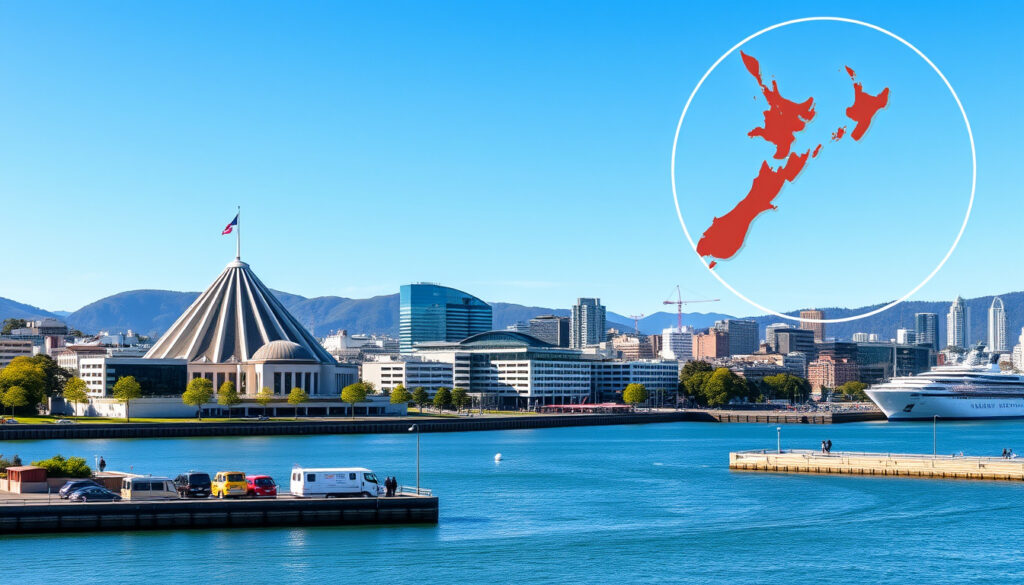
What Is the Capital of New Zealand? Wellington, Not Auckland.
Ask someone what New Zealand’s capital is and you might get a quick “Auckland” — but that answer is off by more than a century and a half. The real capital is Wellington, a compact city at the southern tip of the North Island, and the decision to put the seat of government there remains one of the country’s most consequential geographic moves.
Capital since: 1865 ·
Population (Wellington urban): approx. 215,000 ·
Number of capitals in NZ history: 3 ·
Largest city: Auckland ·
First capital location: Old Russell (Okiato)
Quick snapshot
- Wellington has been New Zealand’s capital since 1865 (Wellington City Council – municipal archives)
- Auckland was capital from 1841 to 1865 (NZHistory – official history site)
- First capital was Old Russell (Okiato) in 1840–1841 (Wikipedia – community encyclopedia)
- Exact population figures for Wellington city proper vs. metro vary across sources (Te Ara Encyclopedia of New Zealand – national reference)
- Parliament first sat in Wellington on 26 July 1865, marking the official transfer (Wellington City Archives – official record)
- Ongoing debate about formalising Wellington’s capital status in a written constitution (Te Ara Encyclopedia – constitutional background)
| Fact | Details |
|---|---|
| Capital | Wellington |
| First capital | Old Russell (Okiato) |
| Previous capital | Auckland (1841–1865) |
| Capital since | 1865 |
| Location | Southwestern tip of North Island |
| Population (city proper) | approx. 215,000 |
| Largest city | Auckland (population ~1.5 million) |
What is the capital of New Zealand?
Wellington is the capital city of New Zealand. It sits at the southwestern tip of the North Island and has been the political and administrative centre since 1865. According to Wellington City Council (municipal history records), the city became the seat of government after the capital was transferred from Auckland. Parliament first officially sat in Wellington on 26 July 1865, as documented by the Wellington City Archives (primary source collection).
Where is Wellington located?
Wellington is situated on the southern coast of the North Island, at the narrowest point of the Cook Strait that separates the North and South Islands. Its geography gave it a strategic advantage for governing both islands. The Te Ara Encyclopedia of New Zealand (national reference work) notes that the capital’s central position was a key factor in the 1865 move.
What is the population of Wellington?
The city proper has an estimated population of around 215,000, while the wider metropolitan area exceeds 400,000. However, precise counts vary depending on boundaries and census methodology. The Te Ara Encyclopedia (official government publication) provides authoritative demographic context.
Wellington’s capital status isn’t enshrined in a single written statute — New Zealand has no formal constitution. That means the city’s role rests on convention and practice, not a single legislative act. For travellers and locals alike, the capital is Wellington, full stop.
Is Auckland the capital of New Zealand?
No — Auckland is not the capital. Auckland is the largest city in New Zealand, with a population of roughly 1.5 million, but it lost capital status in 1865. According to NZHistory (government history portal), “Auckland remained a major gateway to New Zealand even after losing capital status,” but the government seat permanently shifted south.
Why do people think Auckland is the capital?
The misconception likely stems from Auckland’s size, international airport, and economic dominance. Many large countries have their largest city as capital (London, Tokyo). New Zealand’s smaller scale and different historical path contribute to the confusion. The Auckland Tourism (regional visitor guide) itself describes the loss of capital status in 1865 as “a blow to Auckland’s pride.”
What is the largest city in New Zealand?
Auckland is the largest urban area by population — approximately 1.5 million — but it is not the political capital. NZHistory (official history site) confirms that Auckland “remained a prosperous port city” after the capital moved.
For anyone planning a visit or studying New Zealand’s governance, confusing Auckland with the capital would mean missing the actual political, judicial, and diplomatic centre. Wellington’s Parliament, Supreme Court, and foreign embassies all operate there — not in Auckland.
Why is Auckland no longer the capital?
Auckland served as capital from 1841 to 1865, but the decision to move stemmed from geographic and political concerns. According to Waitangi Treaty Grounds (cultural and historical authority), “Wellington was selected for its central location and good harbour after visits to several possible sites.” South Island members of parliament had to travel by ship to Auckland, and a more central location made governance more practical for the entire colony.
What was the first capital of New Zealand?
The first capital was Old Russell (Okiato), a small settlement on the Northland coast. It served only from 1840 to 1841, after the Treaty of Waitangi was signed. Wikipedia (community encyclopedia) lists it as the initial seat of government, though its time was brief.
What was the second capital of New Zealand?
Auckland became the second capital in March 1841 when Governor William Hobson established his government there. Te Ara (national encyclopedia) explains that Hobson chose Auckland because it already had a growing European population and a good harbour.
Why was Wellington chosen as the capital?
Wellington was chosen for its central location between the North and South Islands, its sheltered harbour, and the need to accommodate South Island representatives. Waitangi Treaty Grounds (historical trust) notes that “the Auckland move was driven by South Island members having to travel by ship to the seat of government.” The shift was completed in 1865.
The implication: New Zealand’s capital history shows a pragmatic, island-spanning logic — not a single city winning by default.
Does New Zealand have two capitals?
No. New Zealand has only one capital: Wellington. There is no capital in the South Island. Wellington is located on the North Island, at the southwestern tip. Te Ara (official encyclopedia) states that “Wellington is the location of New Zealand’s Parliament, executive government, official residences, and highest judicial bodies.”
What is the capital of New Zealand South Island?
No South Island city serves as a capital. Some official functions, like the High Court in Christchurch or government agencies in Dunedin, operate locally, but the political capital remains solely Wellington. The Te Ara (national reference) clarifies that all central government institutions are Wellington-based.
Does New Zealand have a capital in the South Island?
There is no capital in the South Island. The only capital city is Wellington, on the North Island. This is a common point of confusion because the country has two main islands, but the UK model of a single capital applies.
Timeline: New Zealand’s capital moves
| Period | Capital | Key note |
|---|---|---|
| 1840–1841 | Old Russell (Okiato) | First capital after Treaty of Waitangi (Wikipedia) |
| 1841–1865 | Auckland | Governor William Hobson established government (Te Ara) |
| 1865–present | Wellington | First parliamentary session 26 July 1865 (Wellington City Council) |
Three capitals in 25 years — but Wellington has been the settled choice for over 150 years.
What’s confirmed vs. still uncertain
Confirmed facts
- Wellington is the current capital of New Zealand (Wellington City Council)
- Auckland is the largest city, not the capital (NZHistory)
- The first capital was Old Russell (Okiato) (Wikipedia)
- Auckland was capital from 1841 to 1865 (Te Ara)
What remains unclear
- Exact population of Wellington city proper vs. metro varies by source (Te Ara)
- The legal basis for Wellington’s capital status is based on convention rather than a formal statute, which some consider uncertain (Wikipedia – community encyclopedia)
- The reasons for the capital move are interpreted differently by historians, with some emphasizing geography and others political pressure (Waitangi Treaty Grounds – cultural and historical trust)
- Whether Old Russell (Okiato) is universally accepted as the first capital is debated due to its brief tenure and limited records (Wikipedia – community encyclopedia)
Editorial perspective: What the capital shift means for New Zealand
“Wellington’s capital status is not protected by a supreme national statute because New Zealand has no formal written constitution.”
Te Ara Encyclopedia of New Zealand (national reference work)
“Auckland remained a major gateway to New Zealand even after losing capital status.”
NZHistory (official history portal)
“The move to Wellington for its central location reflected the need to unify the two islands.”
Waitangi Treaty Grounds (cultural and historical trust)
For the traveller planning a New Zealand itinerary, the choice is straightforward: Wellington for the political heart, Auckland for the commercial pulse. The capital’s historical journey from Old Russell to Auckland to Wellington mirrors the country’s own struggle to find a centre that works for everyone — a lesson in geography, not pride. For more on New Zealand history, read our guide to Anzac Day.
Related reading: Find Dominion Post Death Notices Wellington · What Day is Anzac Day? Date, History & Traditions
en.wikipedia.org, en.wikipedia.org, democracyaction.org.nz, nzpressline.net, en.wikipedia.org
Frequently asked questions
What is the current capital of New Zealand?
Wellington is the capital city of New Zealand, located at the southwestern tip of the North Island. It has held that status since 1865.
Is Auckland currently the capital of New Zealand?
No. Auckland is the largest city but not the capital. It served as capital from 1841 to 1865.
Why did the capital move from Auckland to Wellington?
The move occurred because Wellington was more centrally located for both the North and South Islands, making governance easier, especially for South Island representatives who had to travel by ship.
Which location served as New Zealand’s first capital?
The first capital was Old Russell (Okiato) in Northland, serving from 1840 to 1841.
Is New Zealand expensive to visit?
New Zealand can be moderately expensive, especially in major cities like Auckland and Queenstown. However, budget options exist in smaller towns and hostels.
How many days is enough for New Zealand?
A minimum of two weeks is recommended to see both islands, but many travellers spend three to four weeks for a relaxed itinerary.
What is the best month to visit New Zealand?
The summer months (December to February) offer warm weather and outdoor activities. For skiing, winter (June to August) is best in the South Island.
First‑time visitors: Do not book your flights assuming Auckland is the capital. You’ll want to land in Auckland for its international gateway, but plan a separate trip to Wellington to see the Beehive and Parliament.
More related posts
 Doubtful Sound Overnight Cruise: Worth It? Guide & Reviews
 How to Make Banana Cake: Easy Recipe for Moist & Fluffy Cake
 Motorola Edge 60 Pro Review: Specs, Battery & Price
 When Is Zootopia 2 Coming Out? Theatrical & Disney+ Dates
 Postie Te Awamutu: Hours, Location, Sales & More
 Home Loan Rates Drop: Will They Fall to 3%? | 2025 Predictions
 Look Sharp St Lukes – What Our Investigation Revealed
 Tāmaki Makaurau by-election 2025 results, meaning, and map