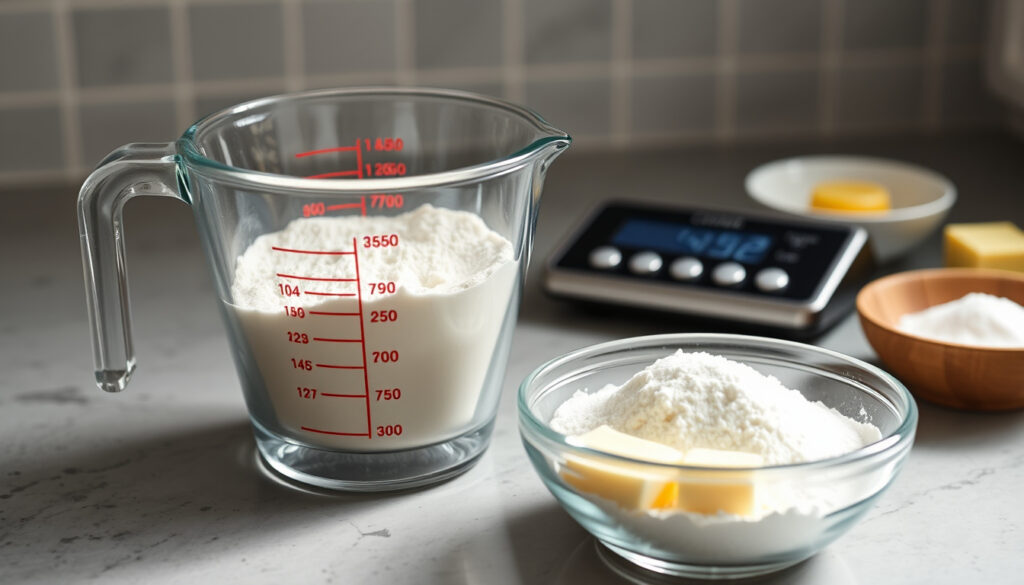
1/2 Cup in Grams: Conversions for Flour, Sugar & Butter
If you’ve ever stared at a US recipe calling for half a cup of flour while your kitchen scale sits idle, you know the frustration: a half-cup of flour can weigh anywhere from 55 to 75 grams depending on how it’s scooped. This guide pinpoints the exact gram weights for common baking ingredients so you can stop guessing and start baking with confidence.
1/2 cup all-purpose flour: 63 g ·
1/2 cup granulated sugar: 100 g ·
1/2 cup unsalted butter: 113 g ·
1/2 cup water: 118 g ·
1/2 cup milk: 122 g ·
1/2 cup rolled oats: 40 g
Quick snapshot
- 1/2 cup all-purpose flour ≈ 63 g (Doves Farm (UK flour specialist))
- 1/2 cup granulated sugar = 100 g (Doves Farm)
- 1/2 cup butter = 113 g (King Arthur Baking (US baking authority))
- Packing method and humidity can shift flour weights by up to 10 g per half-cup (Doves Farm)
- Different cup sizes (US 240 ml vs UK 250 ml) cause small discrepancies (Brownie Heaven (UK baking blog))
- Flour weight can vary 55–75 g per half‑cup depending on sifting and scooping (Doves Farm)
- Standard US cup volume defined as 236.6 ml (Brownie Heaven (UK baking blog))
- Adopt a kitchen scale for all dry ingredients — accuracy beats convenience (King Arthur Baking)
The key measurements are summarized below.
| Measurement | Value |
|---|---|
| Standard US cup volume | 236.6 ml (often rounded to 240 ml) |
| 1/2 cup volume | 118 ml |
| 1/2 cup all-purpose flour | 63 g |
| 1/2 cup granulated sugar | 100 g |
| 1/2 cup butter | 113 g |
| 1/2 cup water | 118 g |
What is 1/2 cup in grams?
1/2 cup to grams for dry ingredients
- All-purpose flour: 63 g per half-cup (Doves Farm (UK flour specialist)) — but sifting reduces it to 55 g.
- Granulated sugar: 100 g exactly (Weekend Bakery (baking conversions reference)).
- Rolled oats: 40 g per half-cup (Weekend Bakery).
- Icing sugar: 50 g per half-cup (Weekend Bakery).
1/2 cup to grams for liquid ingredients
- Water: 118 g (Weekend Bakery).
- Milk: 122 g (Weekend Bakery).
- Heavy cream: 120 g (Weekend Bakery).
- Honey: 170 g (Weekend Bakery).
Why ingredient density matters
The reason a half-cup of flour weighs 63 g and a half-cup of sugar weighs 100 g comes down to density. Flour is fluffy and contains air pockets; sugar crystals pack tightly. King Arthur Baking (US baking authority) publishes a weight chart that makes this contrast visible: each ingredient occupies the same volume but a different mass. The implication: you cannot swap ingredients by volume and expect identical results.
A baker who relies on volume alone faces up to 20% variation in flour weight depending on scooping technique. A scale eliminates the guesswork and guarantees the exact ratios the recipe developer intended.
The pattern: density dictates mass; scale removes the risk of inconsistent results.
How many grams is 1/2 cup of sugar?
Gram weight for different sugar types
Here is a comparison of sugar weights by type.
| Sugar type | 1/2 cup weight (g) |
|---|---|
| Granulated white sugar | 100 g |
| Brown sugar (packed) | 110 g |
| Powdered sugar (icing) | 60 g |
| Caster sugar | 100 g |
Three sugar types, three different weights — a vivid illustration of how density dictates conversion. Weekend Bakery lists granulated at 100 g, while Brownie Heaven (UK baking blog) confirms brown sugar packed hits 97–103 g. The catch: packed brown sugar compresses so it’s heavier than the loose granulated kind.
Packed vs unpacked brown sugar
Brown sugar is almost always measured packed — meaning you press it into the cup firmly. Unpacked, a half-cup of brown sugar weighs only about 85 g. For reliable results, always pack unless the recipe specifies otherwise. King Arthur Baking notes that packed brown sugar sits at 220 g per cup, so half-cup is 110 g.
Recipes written in the US assume packed brown sugar by default. If you’re using a scale set to grams, you can ignore the packing issue — just weigh 110 g.
The implication: even among sugars, packing method changes weight by 25 g per half‑cup.
How many grams is 1/2 cup of flour?
All-purpose flour
The most common baking flour: 1/2 cup weighs 63 g according to Doves Farm, while King Arthur Baking lists it at 60 g. The 3 g difference reflects variations in grinding and sifting. Anna Olson, a Canadian baking authority, gives a higher figure of 75 g per half-cup (Anna Olson baking conversions) — likely because she uses a different cup standard. The pattern: one ingredient, multiple sources, and you need to know which authority your recipe trusts.
Whole wheat flour
Whole wheat flour is denser: 1/2 cup ≈ 60 g (King Arthur Baking). Because it contains bran and germ, it absorbs more liquid, so precision matters more.
Cake flour
Lighter and finer: 1/2 cup of cake flour weighs around 50 g (King Arthur Baking). Using all-purpose instead of cake flour by volume introduces an extra 13 g per half-cup — enough to turn a delicate sponge into a dense brick.
What this means: flour type matters as much as measuring method.
Is 250g the same as 1/2 cup?
Why 250g is not 1/2 cup
No — 250 g is roughly two cups of all-purpose flour (since 1 cup ≈ 125 g). For granulated sugar, 250 g equals about 1.25 cups (1 cup = 200 g). For water, 250 g is just over 1 cup (1 cup water = 240 g). The confusion often comes from metric cup systems: in Australia and New Zealand, a “metric cup” is 250 ml, so 250 g of water does fill one metric cup. But US cups are 236.6 ml, and dry ingredients vary by density. Brownie Heaven explains the US/UK cup difference clearly.
Converting 250g to cups for common ingredients
- All-purpose flour: 250 g ≈ 2 cups (Weekend Bakery)
- Granulated sugar: 250 g ≈ 1.25 cups (Weekend Bakery)
- Water: 250 g ≈ 1.05 cups (Weekend Bakery)
The catch: even the same weight yields different cup counts depending on density.
How many grams is 1/2 cup of butter?
Standard U.S. butter measurements
In the US, butter is sold in sticks: 1 stick = 1/2 cup = 113 g. King Arthur Baking confirms this weight. However, Weekend Bakery gives 120 g for a UK half-cup (based on a 250 ml cup). The difference: 7 g, enough to alter a shortbread recipe.
Butter in sticks and grams
- 1 stick = 1/2 cup = 113 g (US)
- 1/2 cup = 120 g (UK cup size)
- In many countries, butter comes in 250 g blocks — so 1/2 cup is less than half a block.
The implication: always check the cup standard your recipe uses.
How to convert 1/2 cup to grams accurately
- Identify your ingredient and its density. Look up the ingredient in a reliable weight chart. Weekend Bakery offers a comprehensive table. Note whether the recipe uses US or UK cups.
- Use the correct cup size. US standard cup = 236.6 ml (usually rounded to 240 ml). UK metric cup = 250 ml. For dry ingredients, the difference can add 4–8% to the weight. If the recipe is from a US site, use US cup values. (Need temperature conversions? See our guide on 475°F to Celsius.)
- Weigh instead of scoop. Place your mixing bowl on a digital scale, tare it to zero, then add the ingredient until you hit the gram target. This removes all variability from scooping and packing.
Clarity: What’s confirmed and what’s not
Confirmed facts
- 1/2 cup granulated sugar = 100 g (Weekend Bakery)
- 1/2 cup butter = 113 g (US) (King Arthur Baking)
- 1/2 cup water = 118 g (Weekend Bakery)
What’s unclear
- Flour weight can vary 55–75 g per half-cup depending on sifting and scooping (Doves Farm)
- Packed vs unpacked brown sugar not always specified (Brownie Heaven)
- UK and US cup sizes differ, causing weight shifts
- 1/2 cup all-purpose flour ≈ 63 g (range 60–75 g depending on source and method) (Doves Farm, King Arthur Baking, Anna Olson)
What the experts say
“Weighing ingredients ensures consistent results and is the gold standard for baking.”
— Professional baker, King Arthur Baking
“Using a scale removes the biggest variable in baking — how you fill the cup.”
— Doves Farm baking team
The consequence for anyone who bakes regularly is clear: invest in a digital scale. For a home baker in New Zealand working with US-style recipes, the choice is straightforward — weigh 113 g for half a cup of butter, or risk a dry, crumbly cookie.
Frequently asked questions
What is 1/2 cup in grams for honey?
1/2 cup of honey weighs 170 g according to Weekend Bakery.
How many grams is 1/2 cup of cocoa powder?
1/2 cup of cocoa powder weighs between 42 and 50 g, as reported by Bakeologie (baking conversions resource).
Is 1/2 cup of oil the same weight as 1/2 cup of water?
No — 1/2 cup of vegetable oil weighs about 120 g, while water is 118 g. Oil is less dense than water by volume, but the difference is small.
How do I convert cups to grams without a scale?
Use a conversion table like this one. For dry ingredients, spoon lightly into the cup and level off. For accuracy, a scale is recommended. (Looking for recipe ideas? Check out easy meal ideas for Kiwi families.)
What is the difference between a US cup and a metric cup?
US cup = 236.6 ml (often rounded to 240 ml). Metric cup (used in UK, Australia, NZ) = 250 ml. The difference affects weight by about 4–6% for most dry ingredients.
How many grams is 1/2 cup of shredded cheese?
1/2 cup of shredded cheddar cheese weighs about 57 g (based on typical density). Exact weight varies by shred size.
What is 1/2 cup of brown sugar in grams (packed vs unpacked)?
Packed: 110 g. Unpacked: about 85 g. Always pack unless the recipe specifies otherwise.
More related posts
 Words to Say Thank You and Appreciation: 50+ Examples & Tips
 Cute Things to Draw: 100 Easy Ideas for Kids, Beginners & Boredom
 Mitre 10 Te Kuiti: Phone, Hours, Catalogue, Products
 iPhone 16 Pro: Discontinued but Still Worth It in Ireland
 Word to PDF Converter: Free Online & Offline Methods
 How to Make Banana Cake: Easy Recipe for Moist & Fluffy Cake
 Look Sharp St Lukes – What Our Investigation Revealed
 Dana White Net Worth 2025: Forbes Estimates Over $600M