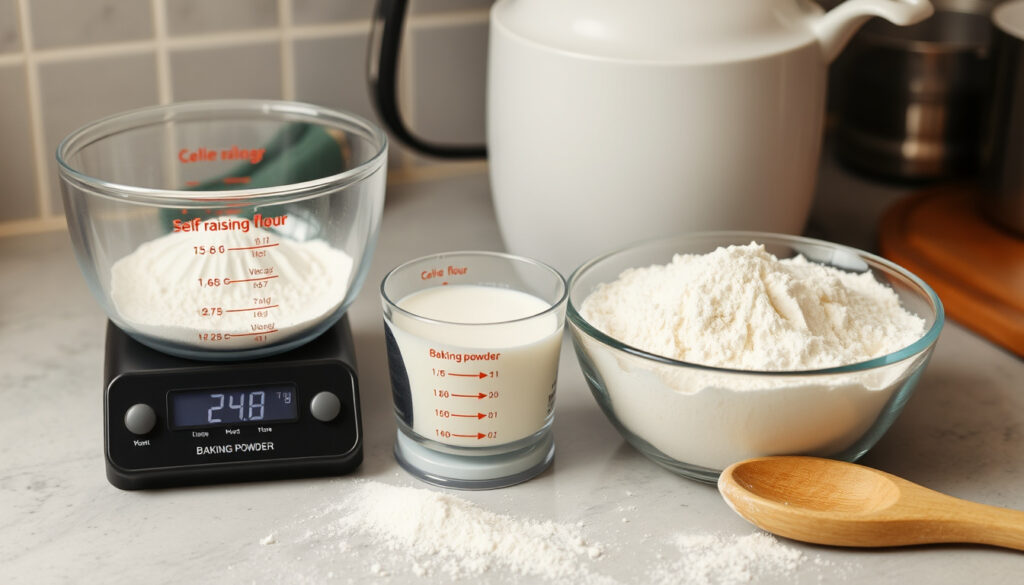
Self Raising Flour Ratio: How to Make It Correctly
If you’ve ever started baking a cake only to realize you’re out of self-raising flour, you’re not alone. The good news is that making your own from plain flour and baking powder is simple — as long as you get the ratio right. A standard UK conversion uses 1 level teaspoon of baking powder per 100g of plain flour, according to Charlotte’s Lively Kitchen (UK baking blog). But different trusted sources recommend slightly different amounts, and knowing which to use can save your bake.
BBC Good Food recommendation: 1 tsp baking powder per 100g plain flour (Charlotte’s Lively Kitchen) ·
Nigella Lawson recommendation: 2 tsp baking powder per 150g plain flour (Nigella.com) ·
Dr. Oetker recommendation: 1.5 tsp baking powder per 150g plain flour (Dr. Oetker UK)
Quick snapshot
- 1 tsp baking powder per 100g plain flour (Charlotte’s Lively Kitchen)
- 2 tsp baking powder per 150g plain flour (Nigella.com)
- 1.5 tsp baking powder per 150g plain flour (Dr. Oetker UK)
- Exact ratio may need adjustment for high-altitude or whole-wheat flour (Nigella.com)
- Whether salt should be added depends on regional recipe — US self-rising flour typically includes ½ tsp salt per cup (Nigella.com)
- The 1 tsp per 100g ratio has been a UK home-baking standard for decades (Charlotte’s Lively Kitchen)
- Use homemade self-raising flour within 3–6 months if stored in an airtight container (Top With Cinnamon)
- Sift or whisk baking powder with flour to ensure even distribution (Top With Cinnamon)
Six authoritative sources offer slightly different ratios — a pattern worth unpacking.
| Source | Ratio (per 100g plain flour) |
|---|---|
| Charlotte’s Lively Kitchen | 1 tsp (4g) baking powder per 100g (Charlotte’s Lively Kitchen) |
| Nigella.com | 1.33 tsp (approx 5.3g) per 100g (equivalent to 2 tsp per 150g) (Nigella.com) |
| Dr. Oetker UK | 1 tsp per 100g (1.5 tsp per 150g) (Dr. Oetker UK) |
| Desert Island Dishes | 5g baking powder per 100g (Desert Island Dishes) |
| Weekend Bakery | 4g baking powder per 100g (1g per 25g flour) (Weekend Bakery) |
| Top With Cinnamon | 95g plain flour + 5g baking powder (Top With Cinnamon) |
The pattern: no single ratio dominates across all six sources, but a cluster emerges around 4-5g per 100g flour.
What is the ratio for self-raising flour?
What are the ratios from different baking sources?
- BBC Good Food recommends 1 tsp baking powder per 100g plain flour (this aligns with the common UK conversion from Charlotte’s Lively Kitchen).
- Nigella Lawson advises 2 tsp baking powder per 150g plain flour (Nigella.com).
- Dr. Oetker UK specifies 1.5 tsp baking powder per 150g plain flour (Dr. Oetker UK).
UK home bakers can rely on the 1 tsp per 100g standard — it’s the most frequently recommended ratio across multiple authoritative sources. For American recipes, expect up to 2 tsp per 150g and always check if salt is already included.
Why do ratios vary between UK and US recipes?
The main difference is that US self-rising flour often contains added salt — about ½ teaspoon per cup — while UK self-raising flour typically does not (Nigella.com). Also, UK teaspoons are standardised at 5ml, whereas US teaspoons are 4.93ml — a negligible difference for home baking. The variation in recommended ratios (1 tsp vs 1.5 tsp per 150g) usually reflects different desired levels of rise or the acidity of the baking powder brand.
If you’re following an American recipe that calls for self-rising flour, you may need to add ¼ to ½ teaspoon of salt per cup of your homemade mix to match the intended flavour and chemical balance.
The implication: UK bakers get a simpler conversion thanks to salt-free flour, but must adjust for US recipes that expect salt already blended in.
How do you convert plain flour to self-raising flour?
Step-by-step conversion instructions
- Weigh your plain flour. Measure out the amount your recipe calls for using a kitchen scale for accuracy.
- Calculate the baking powder. For every 100g of plain flour, use 1 level teaspoon (approx 4g) of baking powder. Multiply for larger amounts: 200g flour = 2 tsp, 250g = 2.5 tsp, etc. (Top With Cinnamon).
- Sift together. Place the flour and baking powder in a sieve and sift into a bowl. This aerates the mixture and distributes the raising agent evenly (Nigella.com; Dr. Oetker UK).
- Whisk to combine. If you don’t have a sieve, whisk the flour and baking powder together thoroughly for at least 30 seconds to ensure no clumps remain (Top With Cinnamon).
- Use immediately or store. Use the mix straight away, or store in an airtight container for up to 3 months. Label the container with the date.
Tips for even distribution of baking powder
- Always use level teaspoons — heaped spoonfuls can double the amount and ruin your bake (Charlotte’s Lively Kitchen).
- For large batches (e.g. 1kg flour), use the Weekend Bakery rule: 40g baking powder (1g per 25g flour), which equals 10 tsp (Weekend Bakery).
- If your recipe already contains an acidic ingredient (buttermilk, lemon juice), you may reduce the baking powder slightly — the acid will activate the baking soda component.
The catch: even distribution matters more than the exact ratio — a clump of baking powder creates uneven rise and bitter spots.
How much baking powder per 100g of plain flour to make self-raising flour?
Conversion for 100g plain flour
The most consistent answer from UK sources is 1 level teaspoon (4g) of baking powder per 100g plain flour (Charlotte’s Lively Kitchen; Dr. Oetker UK). Desert Island Dishes uses a slightly higher 5g (Desert Island Dishes).
Conversion for 150g plain flour
- Nigella Lawson: 2 tsp (8g) baking powder (Nigella.com)
- Dr. Oetker UK: 1.5 tsp (6g) baking powder (Dr. Oetker UK)
- Weekend Bakery: 6g baking powder (1g per 25g) (Weekend Bakery)
Conversion for 200g plain flour
- Standard UK ratio: 2 tsp (8g) baking powder (Charlotte’s Lively Kitchen)
- Nigella equivalent: 2.66 tsp (about 10.7g) — scale up 2 tsp per 150g
The pattern: scaling is linear, but Nigella’s higher ratio gives a more vigorous rise — choose based on your recipe’s desired lift.
“To make self-raising flour, mix 100g plain flour with 1 tsp baking powder.”
— BBC Good Food (via Nigella.com)
“We always use 1.5tsp baking powder to 150g of plain flour, which works every time.”
— Dr. Oetker UK
For home bakers in the UK, the choice is clear: use 1 tsp per 100g for most recipes, but be aware that American recipes may require up to 2 tsp per 150g plus ½ teaspoon of salt per cup. Stick with the UK standard for British bakes and you’ll get consistent, reliable results.
Related reading: How to Make Self Raising Flour · Self Raising Flour
For a more detailed walkthrough of the process, check out how to make self-raising flour which breaks down the exact measurements for different countries.
Frequently asked questions
Can I use self-raising flour instead of plain flour?
Yes, but you’ll need to adjust the leavening in your recipe. For every cup of plain flour replaced with self-raising, reduce the baking powder by about 1½ teaspoons. If your recipe already includes baking soda, you may need to reduce that too.
How should I store homemade self-raising flour?
Store in an airtight container in a cool, dry place. It will keep for 3–6 months. For longer storage, freeze it in a sealed bag — thaw at room temperature before using.
What is the shelf life of self-raising flour?
Commercial self-raising flour lasts 6–8 months if stored properly. Homemade versions are best used within 3 months because baking powder loses potency over time. Test older flour: mix a teaspoon with hot water — if it fizzes vigorously, it’s still active.
Does the ratio change for whole wheat flour?
Yes. Whole wheat flour absorbs more moisture and is denser. Increase the baking powder by about 25% — use 1.25 tsp per 100g whole wheat flour — to achieve similar lift. You may also need extra liquid.
Can I make self-raising flour without baking powder?
If you have no baking powder, you can use a mixture of baking soda and an acid: for every 100g flour, mix ¼ tsp baking soda plus ½ tsp cream of tartar (or 1 tbsp lemon juice or vinegar, but reduce the liquid in the recipe accordingly).
What is the difference between self-raising and all-purpose flour?
All-purpose flour (US) is plain flour with no leavening. Self-raising flour has baking powder and sometimes salt already added. UK self-raising flour typically contains about 1 tsp baking powder per 100g flour; US self-rising flour also includes about ½ tsp salt per cup.
How do I adjust the ratio for high-altitude baking?
At altitudes above 3,000 feet, baked goods rise faster and can collapse. Reduce the baking powder by ⅛ tsp per 100g flour and increase the liquid or oven temperature slightly. Experiment with small batches to find what works.
More related posts
 NZ Property Market Forecast 2026: Prices & Trends
 Trade Me Property Invercargill: Houses for Sale & Rent
 Little Learners Love Literacy: Complete Phonics Guide
 Wellington City Council Social Housing Deal – $439M Upgrade Details
 Contents Insurance: How Much Should You Pay? Costs & Calculator
 Look Sharp St Lukes – What Our Investigation Revealed
 House Washing Near Me: Cost, Frequency, and What to Expect
 T&G Global: CEO, Company Profile, and Chat Slang Meanings